
How Much Does a Crawl Space Vapor Barrier Cost? (CT Pricing Guide)
You went down into the crawl space to chase a musty smell, or a contractor said the words "vapor barrier" during an estimate, and now you are trying to figure out what the thing actually costs. Then you search it and get a mess: one page says a few hundred dollars, the next says twelve grand, and none of them are talking about Connecticut. That spread is not because pricing is random. It is because "crawl space vapor barrier" gets used to describe three very different jobs, and each one carries a different price tag.
Here in Connecticut, damp crawl spaces are a summer specialty. Zone 5A hands us humid July and August air that rolls into a dirt crawl space and condenses on cool ducts and joists, and once the relative humidity down there sits above 55%, mold has everything it needs. This guide breaks down what a crawl space vapor barrier really costs in Connecticut, the difference between a cheap liner and a real system, and where an Energize CT rebate can take a bite out of the bill.
What a Crawl Space Vapor Barrier Actually Is (and What It Isn't)
A crawl space vapor barrier is a plastic sheet that covers the dirt floor and blocks ground moisture from rising into your home. That is the whole job of the barrier by itself. The confusion starts because the same two words get stretched to cover everything from a $200 roll of plastic to a fully sealed and conditioned crawl space, and those are not the same purchase.
Vapor barrier vs. encapsulation: the difference that sets the price
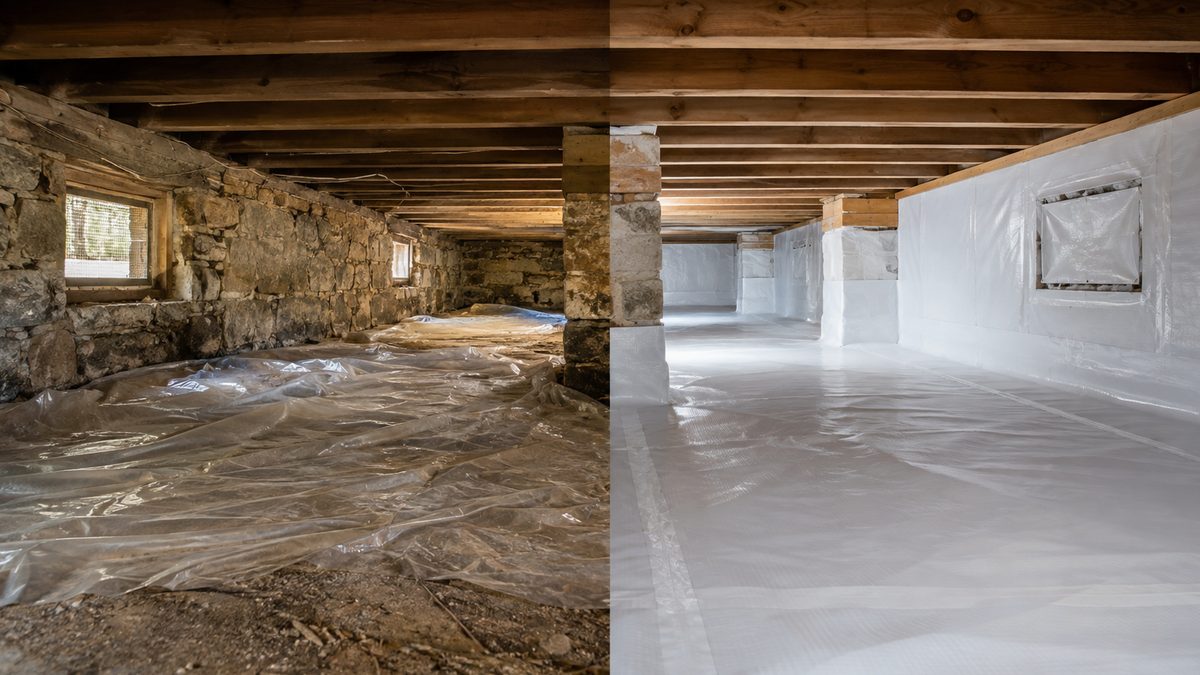
Encapsulation is a full system, while a vapor barrier is one part of it. A bare vapor barrier is just the ground cover. Encapsulation wraps that barrier up the walls, seals the vents and seams, and usually adds insulation and a dehumidifier so the crawl space becomes a dry, semi-conditioned part of the house. If you want the full breakdown of what full crawl space encapsulation actually involves, we cover it separately. For pricing, hold onto this: the more of that system you add, the higher the per-square-foot number climbs.
Not sure whether you should seal the crawl space or leave the vents open?
How Much Does a Crawl Space Vapor Barrier Cost in Connecticut?
In Connecticut, a professionally installed crawl space vapor barrier runs $2.50 to $3.00 per square foot, and a full encapsulation system runs $5.50 to $8.00 per square foot. Those are our own Nealon numbers, not a national average pulled off a calculator site. The difference between the two comes down to how much of the system you are actually buying, which breaks into three honest tiers.
For a typical 1,000 square foot crawl space, that puts a professional barrier around $2,500 to $3,000 and a full encapsulation around $5,500 to $8,000. Bigger or harder-to-reach crawl spaces push the top end up.
Wondering whether the jump to a full system is worth it?
What Drives the Price Up or Down
Two crawl spaces of the same size can price out hundreds of dollars apart because of what is going on down there. Here is what moves the number:
- Square footage: the single biggest factor, since a barrier is priced by the foot
- Crawl height and access: a 2-foot belly-crawl costs more labor than a space you can kneel in
- Old liner removal: pulling out torn, dirty plastic adds time and disposal
- Seam taping and wall run-up: sealing seams and running the barrier up the walls costs more than a loose floor cover
- Pier and column detailing: fieldstone and masonry piers take extra cutting and sealing
- Prep and condition: standing water, debris, or a rodent mess has to be cleared first
- Add-ons: a dehumidifier or a drainage system adds $1,000 or more on top
DIY vs. Hiring a Pro
You can roll out a 6-mil poly liner yourself for a few hundred dollars in materials, and for a dry crawl space that is a fine weekend stopgap. Where it falls apart is everything that makes a barrier work long term: sealing the seams, running it up the walls, fastening it so it does not float around, and detailing it around the piers. A loose sheet of plastic thrown over dirt is a band-aid, not a fix, and it will not hold back a real moisture problem.
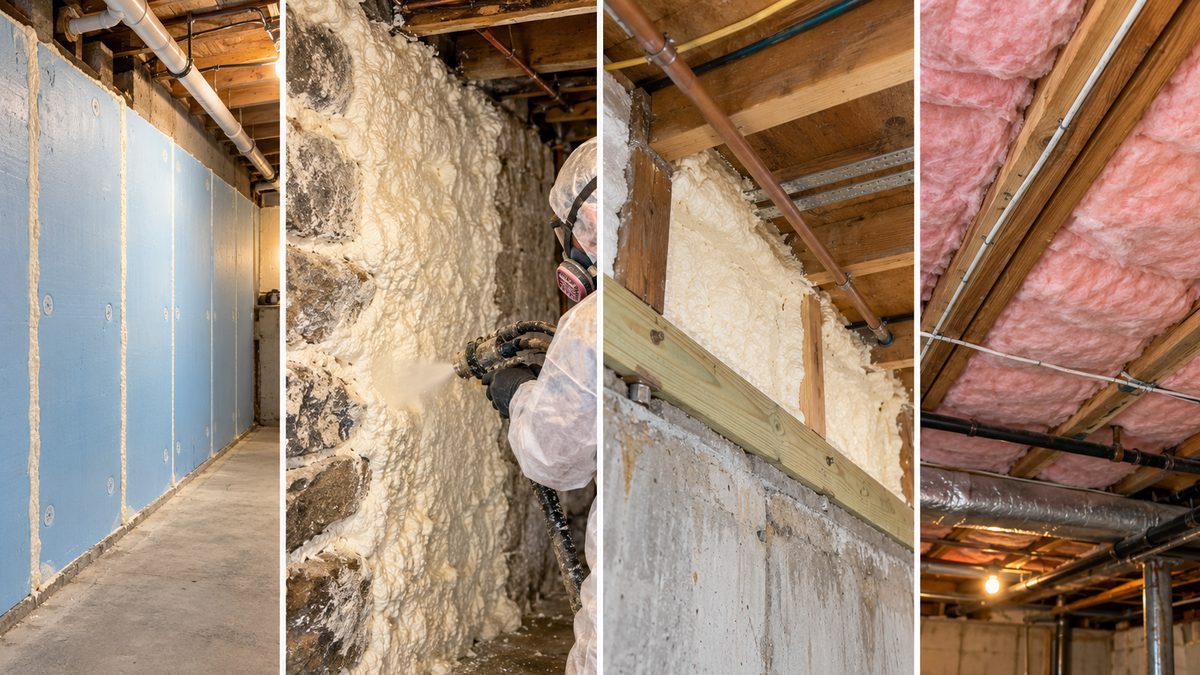
The professional version is also where the barrier usually gets paired with proper crawl space insulation, since a sealed floor over an uninsulated one still lets the cold pour through. Here is the honest line: if a contractor quotes you a big number just to lay a bare barrier with no sealing and no insulation, push back. Either do that part yourself or spend the money on a system that solves the problem.
Wondering which insulation belongs in a sealed crawl space?
How to Tell What Your Crawl Space Needs (Weekend Self-Check)
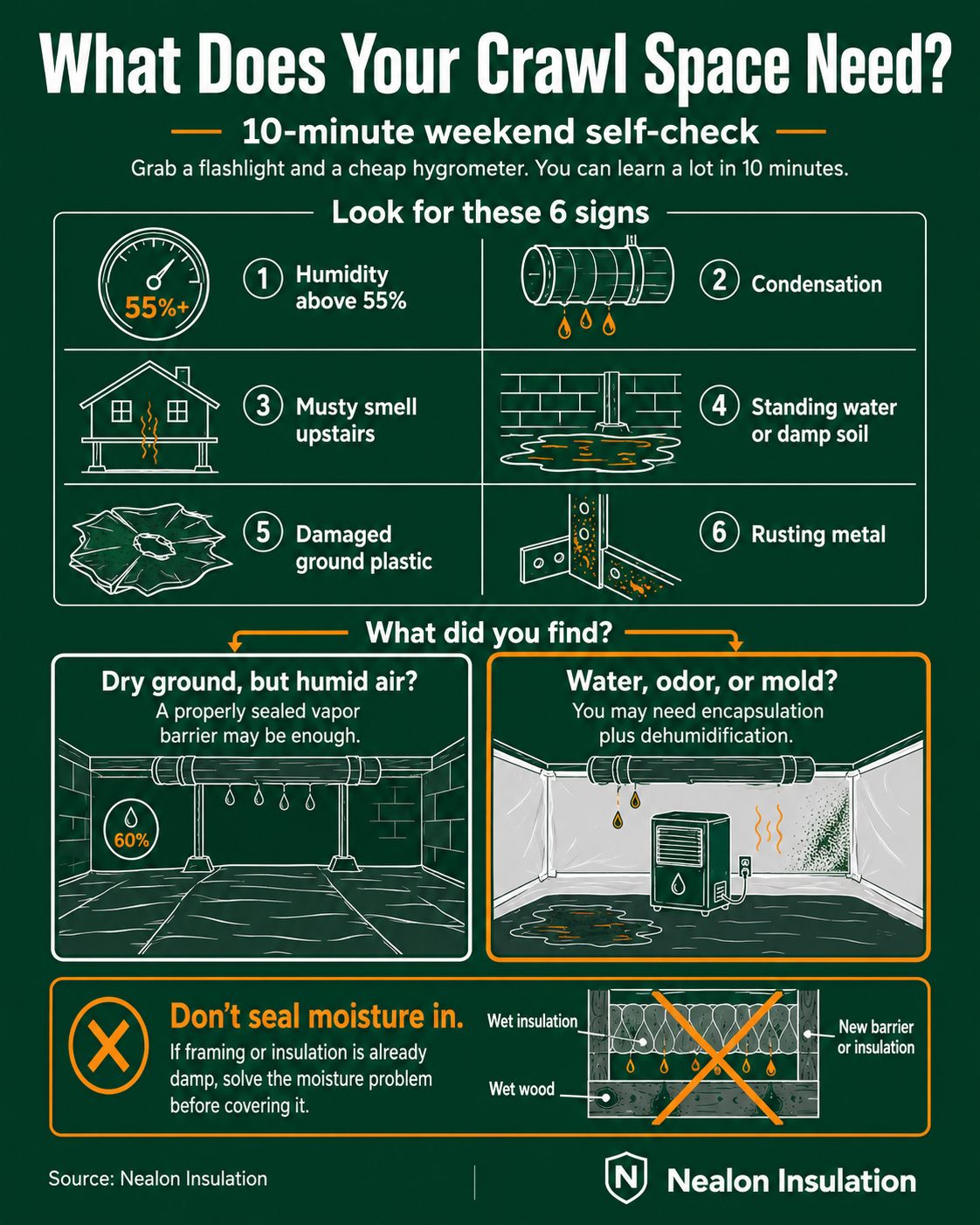
You can figure out which tier you need before any contractor comes out. Spend ten minutes down there with a flashlight and a cheap hygrometer and look for these signs:
- A hygrometer reading above 55% relative humidity
- Condensation or water droplets on ducts, pipes, or floor joists
- A musty, earthy smell in the rooms above
- Standing water or damp soil after rain
- Torn, bunched, or floating plastic already on the ground
- Rusted fasteners, straps, or duct hangers
If you see high humidity and condensation but the soil is dry, a sealed barrier may be enough. If you find standing water, a heavy musty odor, or visible mold, you are into encapsulation and dehumidification territory. And if you are covering an area that is already damp, read up on moisture getting sealed in behind new insulation first, because trapping wet material is worse than leaving it exposed.
Does Energize CT Help Pay for It?
Energize CT can help with the cost, but it pays for insulation, not for the plastic by itself. The program's insulation rebate covers up to $2.00 per square foot or 75% of the project, whichever is less, capped at $10,000 per home, and it starts with a Home Energy Solutions audit that carries a $40 copay as of April 2026. Crawl space insulation that is part of your home's envelope qualifies. A bare vapor barrier on its own is a moisture-control measure, so it does not earn the per-square-foot insulation rebate.
The practical move is to bundle. When you seal and insulate the crawl space together, the insulation portion is rebate-eligible and the barrier rides along as part of the same job. You can see how Connecticut insulation rebates work for the full program details. One caveat: what qualifies depends on your specific assemblies and what the auditor scopes, so confirm the particulars during your audit.
Want to size up your rebate before you commit?
What to Do Next Before You Call Anyone
You can do four things this weekend that make every quote you get more accurate, and none of them costs more than a hygrometer:
- Measure your crawl space square footage. Length times width gets you close enough to sanity-check any per-foot quote.
- Drop a $15 hygrometer down there for a day and write down the humidity.
- Photograph the existing liner, any standing water, and the pier walls.
- Book an Energize CT Home Energy Solutions audit ($40 copay), which is the required first step for any rebate anyway.
The Bottom Line
A crawl space vapor barrier costs what it costs because "vapor barrier" covers three different jobs. A DIY 6-mil liner is a few hundred dollars in plastic, a professional sealed barrier runs $2.50 to $3.00 per square foot, and a full encapsulation system runs $5.50 to $8.00 per square foot. The right number for your house depends on how wet the space is, not on which contractor gives the flashiest pitch.
Before you spend a dime, get down there with a flashlight and a hygrometer and figure out whether you are dealing with a little ground moisture or a genuinely wet crawl space. That one check tells you whether you need a stopgap, a barrier, or the full system, and it keeps you from overpaying for a fix you do not need or underpaying for one that will not hold.
👉 Contact Nealon Insulation — if your Connecticut crawl space needs more than a sheet of plastic, we'll tell you straight what it needs and what it'll cost.
Frequent Questions About Crawl Space Vapor Barriers
How long does a crawl space vapor barrier last?
A professionally installed crawl space vapor barrier lasts 15 to 20 years or more when it uses reinforced 12-mil to 20-mil material with sealed seams. A loose 6-mil DIY liner tears and shifts within a few years under any foot traffic. Reinforced barriers cost more upfront and survive service techs crawling across them. Choose a thicker, fastened barrier to cut replacement frequency and protect the crawl space long term.
Can I install a crawl space vapor barrier myself?
Install a basic 6-mil vapor barrier yourself in a dry, accessible crawl space for a few hundred dollars in materials. DIY installation works as a short-term ground cover but skips the seam sealing, wall run-up, and fastening that stop moisture over the long haul. A wet crawl space, low clearance, or masonry piers push the job to a professional. Roll the liner yourself only if the space is dry and you can move around in it.
Does a vapor barrier fix a wet crawl space on its own?
A vapor barrier alone does not fix a wet crawl space with standing water or active humidity. A barrier blocks ground moisture but does not remove water already in the air or draining in from outside. A wet crawl space needs a full encapsulation system with sealed vents and a dehumidifier to stay dry. Address the drainage and humidity first, then add the barrier, to keep the space dry and protect the framing above.
Is a thicker vapor barrier worth the extra cost?
A thicker vapor barrier is worth the extra cost in any crawl space that sees foot traffic or service visits. A 6-mil liner is cheapest but punctures easily, while a 12-mil to 20-mil reinforced barrier resists tears from techs, tools, and storage. The upgrade adds a modest amount per square foot but cuts how often the barrier needs replacing. Choose reinforced material wherever anyone will crawl through.
How much does it cost to seal a 1,500 square foot crawl space in Connecticut?
Sealing a 1,500 square foot crawl space in Connecticut costs about $3,750 to $4,500 for a professional vapor barrier, or $8,250 to $12,000 for full encapsulation. The barrier-only figure uses the $2.50 to $3.00 per square foot rate, and encapsulation uses the $5.50 to $8.00 rate. Access, old liner removal, and add-ons like a dehumidifier move the final number. Measure your square footage and check the humidity first to land in the right range.
Related Articles
Let's Work Together
Ready to transform your home into an energy-efficient haven? Schedule your free energy assessment today and experience the Nealon difference for yourself.