
Best Basement Insulation: What Works on Each Surface
Cold floors in the living room, a musty smell coming up the basement stairs, and a boiler that never seems to shut off once October hits. In a lot of Connecticut homes, all three problems start in the same place: a basement that was never insulated, or one that was insulated with the wrong material.
Picking the best basement insulation is trickier than it looks, because a basement is not one surface. Concrete walls, the wood ceiling over your head, and the rim joist where the house sits on the foundation each handle heat and moisture differently, and Connecticut's Zone 5A climate punishes the wrong choice with cold winters and sticky summers. Here is what works on each surface, what it costs, and what to check in your own basement first.
The Best Basement Insulation Depends on Which Surface You're Insulating
The best basement insulation is closed-cell spray foam or rigid foam board on the walls, fiberglass batts or mineral wool in the ceiling, and closed-cell spray foam at the rim joist. Each surface has a different job. The walls touch cold, damp concrete, the ceiling separates two living zones, and the rim joist is the leakiest spot in the whole basement.
Here is how the common materials stack up on each surface.
Curious what goes in the attic and walls too? See which insulation works best in each part of the house.
Should You Insulate the Basement Walls or the Basement Ceiling?
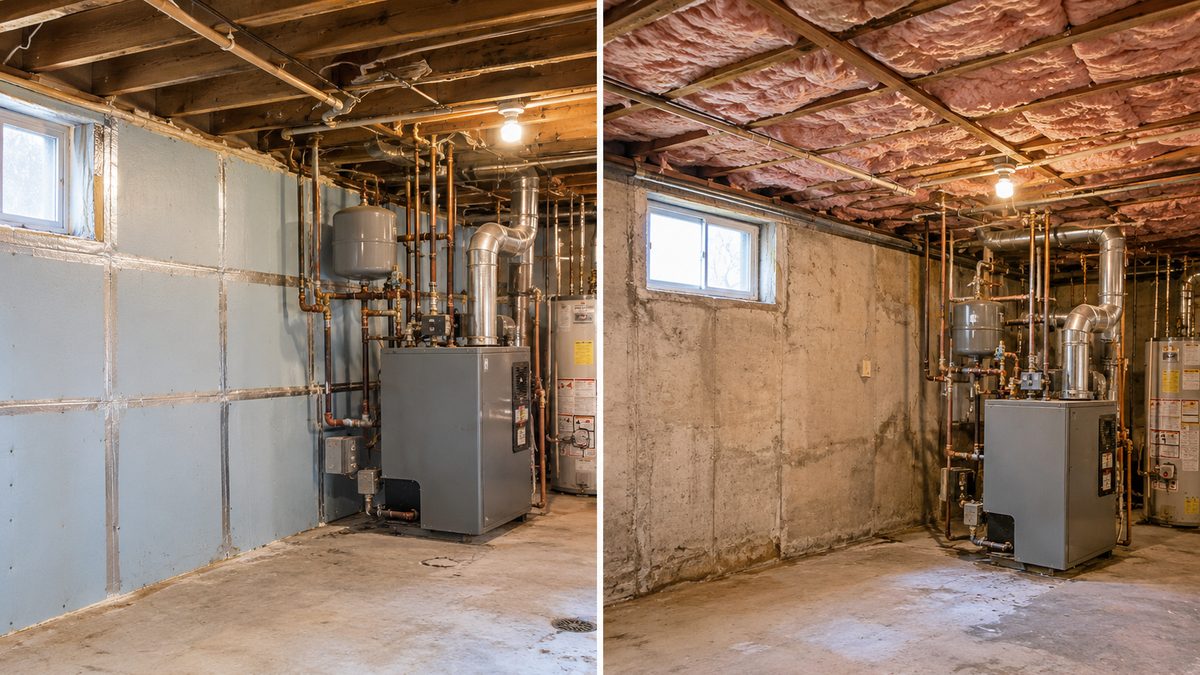
Insulate the basement walls if your basement is heated, finished, or holds the boiler, furnace, ductwork, or water lines. Insulate the basement ceiling if the basement is a cold, unused space you are happy to leave outside the heated part of the house.
Think of your insulation as a line drawn around everything you want to keep warm. Insulate the walls and the basement lands inside that line. Insulate the ceiling and the basement lands outside it, which means it gets colder every winter.
That is fine for a dirt-floor storage room. It is a problem when your boiler, hot water pipes, and ductwork live down there, because they now lose heat into a colder room and your water lines get closer to freezing. In most older Connecticut homes the mechanicals sit in the basement, so the walls are usually the right place to draw the line.
Insulate the ceiling when:
- The basement has no heating equipment, ducts, or plumbing
- You never plan to use or finish the space
- The foundation walls have water problems you can't fix right now
Have a crawl space instead of a full basement? Here's the best crawl space insulation material for Connecticut homes.
Best Insulation for Basement Walls
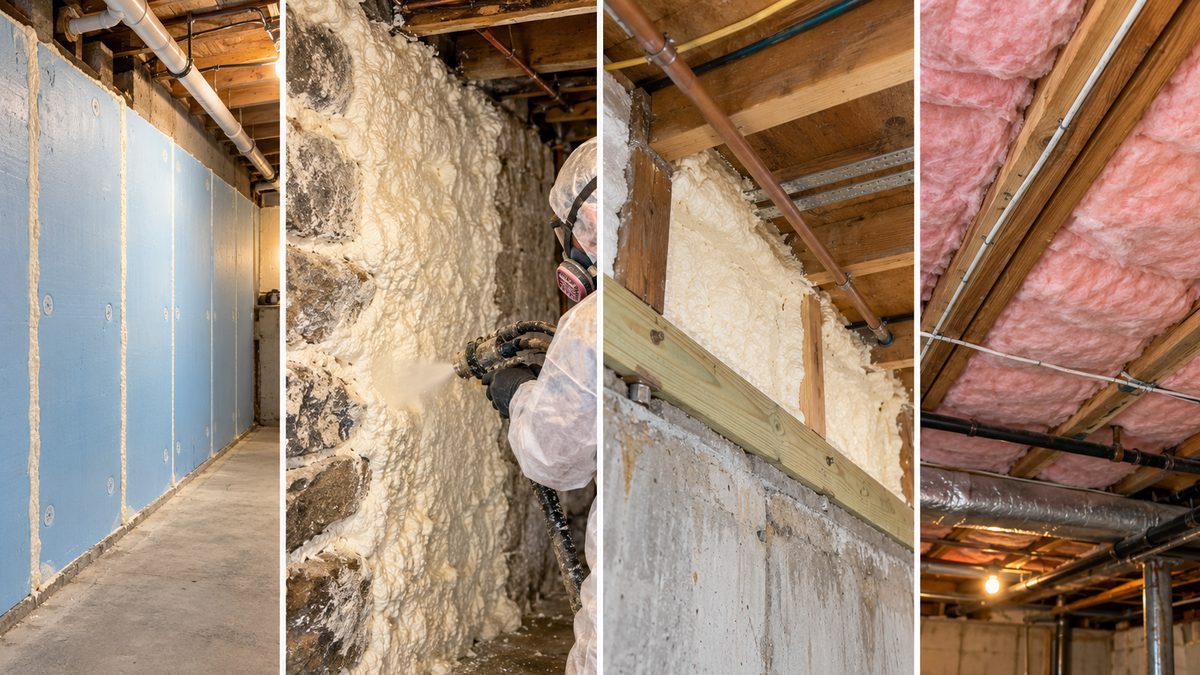
Closed-cell spray foam and rigid foam board are the best insulation for basement walls because both stop air and moisture right at the concrete. Connecticut's energy code targets R-15 continuous insulation or R-19 in a framed cavity for basement walls, and both foams get you there without trapping water.
Closed-Cell Spray Foam
Closed-cell spray foam bonds directly to concrete and delivers about R-6 to R-7 per inch. Roughly 2.5 inches hits the R-15 target. It fills every crack, tie hole, and uneven spot, so warm basement air never reaches the cold wall behind it. If you're weighing foams, here's how closed-cell and open-cell spray foam differ.
The trade-off is that exposed foam in a basement has to be covered by a code-approved thermal barrier, usually half-inch drywall. If you're finishing the space anyway, that drywall was already in the plan.
Rigid Foam Board
Rigid foam board goes straight against the concrete, with every seam taped and every edge sealed with canned foam. Once it's up, you can frame a stud wall in front of it for wiring and drywall.
This is the most DIY-friendly way to insulate basement walls on flat poured concrete. The catch is the sealing: a board with open seams lets humid air slip behind it, which defeats the purpose.
Why Fiberglass Batts Don't Belong Against Concrete
Fiberglass batts fail on basement walls because air moves right through them and hits the cold concrete. In winter and on humid summer days, that air condenses on the wall, and the batt soaks it up like a sponge.
This isn't contractor folklore. The Department of Energy's Building America research on basement insulation systems found that fiberglass or cellulose in contact with basement walls can absorb moisture, and recommends a layer of rigid foam directly against the foundation instead.
The classic result is a finished basement that smells musty two years after the drywall went up. If you open the wall, you find gray, damp batts and mildew on the back of the studs.
Fieldstone and Block Foundations in Older Connecticut Homes
Fieldstone foundations need closed-cell spray foam, because rigid foam board can't sit flat against rock. Plenty of shoreline homes built before World War II still sit on fieldstone, and the walls are uneven, full of mortar joints, and prone to seepage.
We deal with the water before we insulate a fieldstone wall. Gutters, grading, and active leaks come first, because foam sprayed over a wall that is still taking on water only hides the problem. Here's how we go about keeping existing moisture problems from getting sealed in behind insulation. Concrete block walls have a similar issue: the hollow cores move air and moisture, so the wall needs a continuous seal on the inside face.
Best Insulation for the Basement Ceiling
Fiberglass batts and mineral wool are the best insulation for a basement ceiling, installed between the floor joists and pressed tight against the subfloor above. The target for a floor over an unheated basement in Connecticut is R-30.
Fiberglass batts are the budget pick and cover a big ceiling fast. Mineral wool costs more but holds its shape, resists fire, and cuts down the noise traveling up through the floor, which matters if the basement is a workshop. If you go with batts, know when to use faced vs. unfaced insulation before you buy.
Two details make or break a basement ceiling job:
- Air seal first. Every hole drilled for a pipe, wire, or flue is a chimney for cold air. Seal them with foam before the insulation goes in, or the batts just filter the draft.
- Support the batts. Wire supports or netting keep the insulation tight to the subfloor. A batt sagging two inches below the floor leaves an air gap that kills most of its value.
Also remember that any pipes or ducts hanging below the new insulation are now in a colder room, so wrap them too.
Don't Skip the Rim Joist
Closed-cell spray foam is the best insulation for the rim joist because it air seals and insulates the gaps around the sill plate in one pass. The rim joist is the band of lumber that runs around the top of your foundation wall, and in most older homes it's a single board standing between your basement and the outside air.
Stuffing fiberglass into those bays is the most common rim joist mistake we see. Air moves straight through the batt, cold wood sits behind it, and you get condensation, rot, and a highway for mice. That's exactly why we spray foam rim joists instead.
Rigid foam board cut to fit each bay works too, as long as every edge gets sealed with canned foam. It's slow, fiddly work, but it's a reasonable weekend project for a handy homeowner.
Wondering how much heat your rim joist is really losing? Read why the rim joist is the most overlooked spot in your thermal envelope.
Check Your Basement Before You Choose a Material
You can learn most of what decides your basement insulation in one weekend with a roll of tape and a flashlight. Every check on this list is safe to do yourself.
- Run the tape test. Tape a 2-foot square of plastic sheeting tight to a foundation wall and leave it for 48 to 72 hours. Moisture under the plastic means water is coming through the concrete. Moisture on top means humid basement air is condensing on a cold wall.
- Look for white crust or water lines. A chalky white residue on the concrete (efflorescence) or a tide line near the floor means water has been moving through the wall.
- Check the humidity. A basic hygrometer reading above 60% in summer means you need to dry the space out before you insulate.
- Measure what's already in the ceiling. A 3.5-inch fiberglass batt is about R-11, well short of the R-30 target for a floor over an unheated basement.
- Feel the rim joist on a windy day. Run your hand or a lit incense stick along the top of the foundation wall. Moving smoke or daylight at the sill means air is pouring in.
- Note where your mechanicals are. Boiler, furnace, ductwork, and water lines in the basement point toward insulating the walls.
Take photos of anything you find. If the tape test shows water coming through the wall, fixing gutters, downspouts, and grading comes before any insulation, and installing insulation over an active leak is a job for a pro.
What Basement Insulation Costs in Connecticut
Basement insulation in Connecticut typically runs $2.15 to $4.50 per square foot installed, depending on the material and the surface. These are Nealon's ballpark installed ranges before rebates.
To put that in real numbers: a 1,000-square-foot basement ceiling with R-30 fiberglass batts runs about $2,150 to $2,750. A 30-by-40-foot basement with roughly 1,000 square feet of foundation wall comes in around $3,500 to $4,000 for closed-cell spray foam.
Rigid foam board pricing depends on wall height, condition, and how much framing goes in front of it, so that number comes from an on-site look. The other things that push a price toward the high end are tight access, ductwork and pipes crowding the joists, and fieldstone walls.
Energize CT rebates can cover part of the cost on qualifying work, and the exact number for your house comes from a free, no-obligation estimate.
Want to know what actually goes into the number? See how Nealon builds an insulation estimate.
The Bottom Line on Basement Insulation
The best basement insulation comes down to the surface: foam against the concrete walls, fiberglass batts or mineral wool in the ceiling, and closed-cell spray foam at the rim joist. Most Connecticut homes with a boiler or ductwork in the basement are better off insulating the walls, and fiberglass should never touch the concrete.
Before you pick a material, spend a weekend on the tape test and the rim joist check. Knowing whether your walls are wet or dry decides the job more than any product label.
👉 Contact Nealon Insulation about your basement — we'll tell you which surface to insulate and which material will stay dry down there for decades.
Frequent Questions About Basement Insulation
Do I need a vapor barrier on basement walls in Connecticut?
You do not need a plastic vapor barrier on foam-insulated basement walls in Connecticut. Closed-cell spray foam and rigid foam board control moisture on their own, so a sheet of polyethylene adds no protection. Polyethylene sheeting on a basement wall traps moisture between the drywall and the foam, where mold grows out of sight. Skip the plastic and seal every foam seam to keep the basement wall dry and the finished space mold-free.
How long does basement insulation take to install?
Plan on 1 to 2 days to install basement insulation in most Connecticut homes. Basement jobs move quickly because the walls and joists are open, with no attic crawling or wall drilling required. Clear a 3-foot path along the foundation walls before install day to speed up the work and protect stored belongings.
Can I put drywall directly over spray foam on basement walls?
You can put drywall over spray foam on basement walls only when the drywall is fastened to a stud wall or furring strips, not to the foam itself. Spray foam gives screws nothing to grip, so the framing carries the drywall while the foam stays continuous behind it. Half-inch drywall also serves as the thermal barrier code requires over exposed foam in a basement. Frame the wall, then hang half-inch drywall to meet code and finish the space.
Should I insulate my basement before finishing it?
Insulate your basement walls before you frame and drywall a finished basement. Insulation installed against bare concrete stays continuous, while insulation squeezed in after framing leaves gaps behind every stud. Tearing failed insulation out of a finished basement adds $1.25 to $3.00 per square foot in removal costs alone. Insulate the bare walls first to avoid rework, keep the concrete dry, and lower heating costs from day one.
Will insulating my basement prevent mold?
Insulating your basement prevents mold only when the insulation keeps humid air off the cold concrete and the materials tolerate getting damp. Mold needs moisture and food, and paper-faced batts or wood framing pressed against wet concrete supply both. The EPA advises drying wet building materials within 24 to 48 hours to prevent mold growth. Use closed-cell spray foam or rigid foam board on the walls and fix water leaks first to keep the basement dry, protect the framing, and stop musty odors.
Related Articles

Let's Work Together
Ready to transform your home into an energy-efficient haven? Schedule your free energy assessment today and experience the Nealon difference for yourself.