
How to Insulate a Basement in CT: Walls or Ceiling?
If the floors on your first level feel like cold tile every January, or the basement smells a little musty every time you head down to do laundry, the problem starts below your feet. Bare concrete walls and an open rim joist pull cold air and ground moisture into the house all winter, and in Connecticut that shows up on the heating bill fast.
Connecticut makes it worse. We sit in Climate Zone 5A, heating costs rank among the highest in the country, and plenty of shoreline houses were built before 1980 on foundations nobody planned to insulate. This guide covers the decision that comes first, what a proper job looks like, what it costs, and what you can check yourself this weekend.
Walls or Ceiling: The Decision That Comes Before Any Insulation
Where basement insulation goes depends on one question: is the basement inside your home's heated space or outside it? Insulation draws a line: everything on the warm side stays warm, and everything on the cold side gets treated like the outdoors.
When to Insulate the Basement Walls
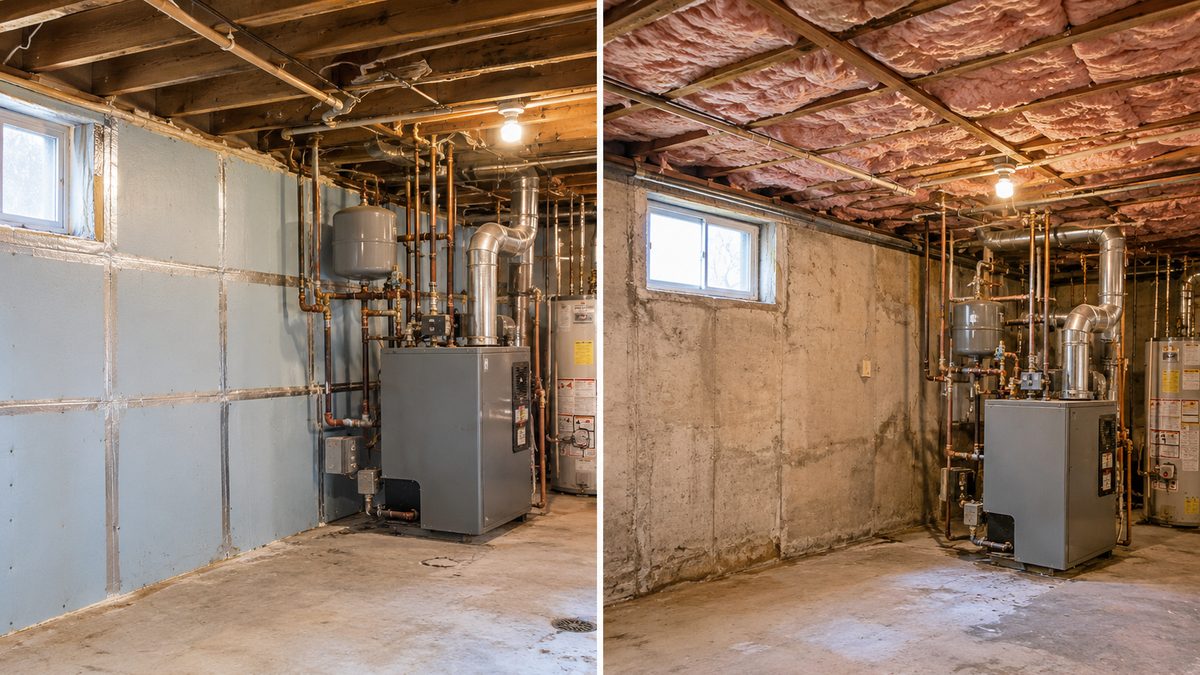
Insulate the basement walls when your furnace, boiler, ductwork, water heater, or water lines live in the basement. That keeps the equipment inside the warm envelope, where it runs more efficiently and the pipes stay safe from freezing. The same goes if you heat the basement or plan to finish it. Most Connecticut basements we walk into fall into this group.
When to Insulate the Basement Ceiling
Insulate the basement ceiling when the basement is truly unheated, holds no mechanical equipment, and will never be living space. You're closing the door on a cold room instead of paying to warm it. It's the cheaper job, but it fits a narrow set of houses.
The choice also affects your rebate, because Energize CT's insulation incentive rules differ for each part of the basement:
- Basement walls: existing insulation of R-4 or less, finished at R-13 or better
- Basement ceiling: existing insulation of R-6 or less, finished at R-19 or better
- Rim joist: existing insulation of R-6 or less, finished at R-13 or better
A heated basement is excluded from the ceiling rebate entirely.
What Connecticut insulation code actually requires for basement walls, attics, and crawl spaces
Check Your Basement Before Anyone Insulates It
Water has to be under control before any insulation goes on a basement wall, because insulation traps whatever moisture is already there. Run these checks before you get a single quote:
- White chalky residue on the concrete: mineral salt left behind by water moving through the wall.
- Stains or tide lines near the floor, or a musty smell that never clears.
- The plastic square test: tape a 2-foot square of plastic sheeting tight to the wall on all 4 edges for 48 hours. Moisture on the wall side means water is coming through the concrete; moisture on the room side means humid air is condensing on a cold wall.
- Downspouts and grading: downspouts that dump at the foundation, or ground sloping toward the house, feed water straight into the basement.
- Existing insulation: measure and photograph anything already on the walls or between the ceiling joists. That number decides rebate eligibility.
Active water gets fixed first. Here's more on making sure existing moisture problems don't get sealed in behind the insulation.
How Basement Walls Get Insulated the Right Way
Basement walls need insulation that tolerates moisture and sits tight against the foundation with no air gap. Connecticut code sets the target at R-15 continuous insulation, R-19 in a framed cavity, or R-13 in the cavity plus R-5 continuous.
Why Fiberglass Batts Against Bare Concrete Fail
Fiberglass batts pressed against a basement wall trap moisture against cold concrete. Humid basement air moves right through the batt, hits the cold wall, and condenses, leaving wet insulation and mold behind a finished wall where nobody sees it for years. That's why the DOE Building America basement wall insulation checklist calls for spray foam or rigid foam panels on basement walls, installed in full contact with the concrete. We tear out plenty of these batt walls, usually after the homeowner notices the smell.
Rigid Foam Board on Poured Concrete
Rigid foam board works best on smooth, flat poured concrete. The boards get glued tight to the wall, and every seam and edge gets sealed so humid air can't sneak around the foam. For more on the material, here's our take on rigid foam board in Connecticut homes.
Closed-Cell Spray Foam on Fieldstone and Block Foundations
Closed-cell spray foam is the right call for fieldstone, rubble, and block foundations. A flat board can't sit tight against a lumpy wall, which leaves exactly the air gaps where condensation starts. Spray foam fills every void, air seals the wall, and slows moisture in one layer. A lot of the older shoreline homes we insulate sit on fieldstone, and spray foam is usually the only option that works there.
Framing and Finishing Over the Foam
Foam insulation in a basement you live in has to be covered by a thermal barrier, which means at least 1/2-inch drywall. For a finished room, a stud wall goes in front of the foam. Batts are fine inside that stud wall because the foam keeps them off the cold concrete, and the combination meets the R-13 plus R-5 code path.
Is blown-in insulation right for crawl spaces or basements?
Don't Skip the Rim Joist
The rim joist is the wood band that sits on top of your foundation, and on almost every older house we inspect, it leaks air. Wall insulation that stops at the top of the concrete leaves it wide open, like wearing a winter coat with the collar unzipped. Closed-cell spray foam seals and insulates it in one pass, which is why we spray foam rim joists on basement jobs.
Why the rim joist is the most overlooked spot in your home's thermal envelope
How a Basement Ceiling Gets Insulated
A basement ceiling gets air sealed first and insulated second. Every hole where plumbing, wiring, or ductwork passes through the floor gets sealed, then batts go into the joist bays, tight against the subfloor and held with supports so they don't sag. The target for a floor over an unheated space in Connecticut is R-30, and Energize CT requires at least R-19 for the rebate.
The catch: anything below that insulation, including water lines and ductwork, now lives in a colder space. Supply lines near the exterior walls can freeze in a hard January, so a ceiling crowded with plumbing points you back to the walls.
What Basement Insulation Costs in Connecticut
Basement insulation in Connecticut typically runs $2.15 to $4.50 per square foot installed, depending on the material and R-value.
Prices are before Energize CT rebates. Your exact number comes from a free, no-obligation on-site estimate.
Here's a worked example. An 800 sq ft basement ceiling insulated with R-30 fiberglass runs roughly $1,700 to $2,200 before rebates. Energize CT pays the lesser of $2.00 per square foot or 75% of the project cost, up to $10,000 per home, so a qualifying job like that could see up to 75% covered. Run your own numbers with our Energize CT insulation rebate estimator.
What moves your price up or down:
- Foundation type. Fieldstone and block walls take more material and time than flat poured concrete.
- Tear-out. Old batts, rotted framing, or moldy drywall have to come out first.
- Access and scope. Crowded mechanicals, low headroom, and adding the rim joist all change the total.
Rigid foam board wall systems vary enough by layout that we price them at the on-site assessment.
What You Can Do Yourself and What Needs a Pro
You can handle the moisture groundwork yourself, but the insulation itself belongs with a pro in most Connecticut basements.
What you can do yourself:
- Extend downspouts away from the foundation and fill low spots where the ground slopes toward the house
- Run a dehumidifier and keep the basement within the EPA's recommended indoor humidity range of below 60%, ideally 30% to 50%
- Run the checklist above and photograph everything you find
What needs a pro:
- Any closed-cell spray foam, which requires specialized equipment and safety gear
- Fieldstone and block foundations, and anything behind existing finished walls
- Any job you want rebated at full value: Energize CT pays up to $2.00 per square foot for work by a contractor in its Insulation Installers Network, versus $0.25 per square foot for DIY work, which still needs an inspection
Your First Step This Week
Run the moisture checklist this weekend and photograph what you find. Then book an Energize CT Home Energy Solutions audit, which costs $40 and is the required first step for every insulation rebate. The auditor measures what you have and issues the rebate application during the visit.
How to book a Connecticut home energy audit through Energize CT
Wrapping Up
Insulating a basement starts with a decision, not a material. Walls and rim joist when the basement holds your equipment or might become living space, the ceiling only when it's truly cold storage, and water control before anything else. On the walls, foam goes against the concrete, never bare fiberglass batts.
Get the order right and the rest falls into place. Insulating the ceiling over a basement full of ductwork is like parking your furnace in the driveway and wondering why it works so hard.
👉 Talk to Nealon Insulation about your basement insulation — we'll tell you whether your walls, rim joist, or ceiling should come first, and which parts qualify for Energize CT rebates.
Frequent Questions About Basement Insulation
Does insulating basement walls make the floors upstairs warmer?
Insulating basement walls makes the floors upstairs warmer because the basement itself stays warmer all winter. An uninsulated concrete wall pulls heat out of the basement, and a cold basement pulls heat through the subfloor from the rooms above. Basement walls insulated to R-15 continuous insulation hold that heat below the first floor. Insulate the basement walls and rim joist together to warm first-floor floors, reduce drafts, and lower heating costs.
Can you insulate a basement that gets water after heavy rain?
A basement that gets water after heavy rain can be insulated only after the water source is fixed. Insulation installed over an active leak traps water against the foundation, which leads to mold and rotted framing within 1 or 2 seasons. Water entry after storms comes from overflowing gutters, short downspouts, or ground that slopes toward the house. Fix drainage first and confirm the walls stay dry through several heavy storms before scheduling insulation.
Can finished basement walls be insulated without tearing them out?
Finished basement walls can be insulated without tearing them out only when an inspection shows the concrete and existing batts are dry. Framed basement walls hide the condition of the concrete, and moisture problems behind finished walls stay invisible until mold or odor shows up. The DOE Building America guidance calls for removing the existing wall, fixing the moisture source, and reinsulating with spray foam or rigid foam when inspection finds moisture. Open a small section of the wall first to check the batts and concrete, then decide between a targeted fix and a full tear-out.
Do basement walls need a plastic vapor barrier?
Basement walls insulated with closed-cell spray foam or rigid foam board do not need a separate plastic vapor barrier. Foam installed tight to the concrete slows moisture movement on its own. Plastic sheeting added behind a stud wall traps moisture between the plastic and the concrete, where the wall has no way to dry. Skip the plastic and let the foam layer control moisture to keep the framing dry and prevent mold.
How much does rim joist insulation cost in Connecticut?
Rim joist insulation in Connecticut costs $2.30 to $3.00 per square foot installed for closed-cell spray foam to R-15, and $2.50 to $3.00 per square foot for fiberglass to R-21. Closed-cell spray foam costs about the same as fiberglass at the rim joist while also air sealing the gaps between the wood and the foundation. Energize CT rebates cover rim joists when the existing insulation is R-6 or less and the finished rim joist reaches R-13 or better. Schedule a free estimate to get an exact price and confirm rebate eligibility.
Related Articles

Let's Work Together
Ready to transform your home into an energy-efficient haven? Schedule your free energy assessment today and experience the Nealon difference for yourself.