
Rim Joist Insulation: The Most Overlooked Spot in Your Home's Thermal Envelope
You crank the thermostat and the first floor still feels cold. The floors are chilly under your socks, there's a draft creeping along the baseboards, and the basement feels like a walk-in cooler. Odds are your attic is insulated, and maybe your walls are too. So what gives? Nine times out of ten in an older Connecticut home, the answer is a strip of bare wood down in the basement that nobody ever thinks to look at.
That strip is the rim joist, and it's the most overlooked spot in your home's thermal envelope. Here in Zone 5A, with cold winters, humid summers, and a lot of housing stock built before anyone bothered sealing this area, the rim joist is where comfort quietly leaks out and, worse, where moisture quietly sneaks in. Here's how to find yours, how to tell if it's a problem, and what it actually takes to fix it.
What a rim joist actually is (and where to find it)
The rim joist is the wooden board that caps the ends of your floor joists where your framing meets the foundation. It runs around the entire perimeter of the house, sitting on top of the sill plate on the concrete, forming the border between your basement or crawl space and the outdoors. Some people call it the band joist. Same piece of wood.
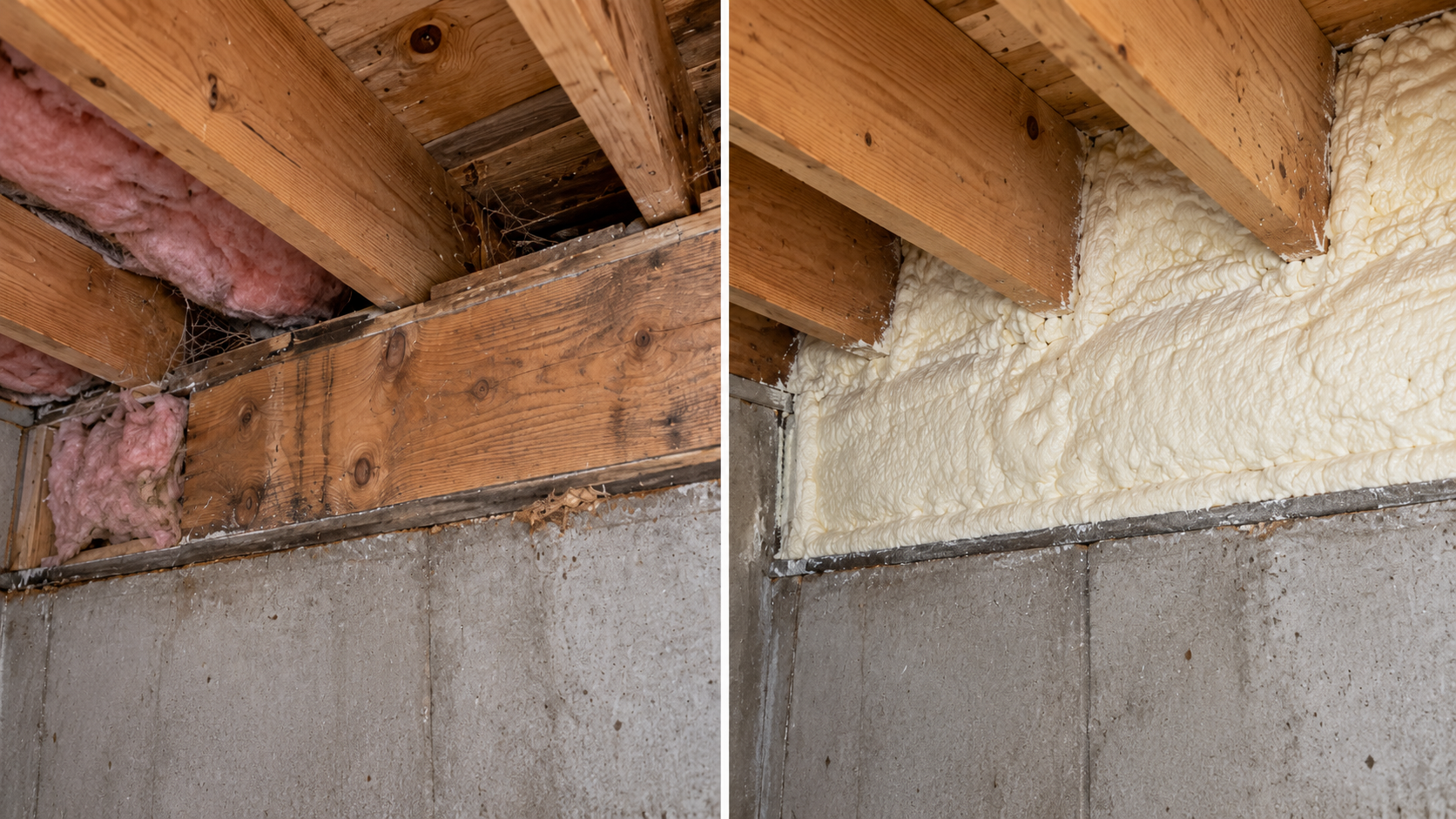
Finding yours takes about a minute. Head down to the basement and look at the outside edge where the wall meets the ceiling. That band of wood running along the top of the foundation, above or behind the sill plate, is the rim joist. In a lot of older Connecticut homes it's bare, or it's got a limp piece of fiberglass shoved into each joist bay that isn't doing much of anything.
In 40-odd years of crawling around Connecticut basements, the bare rim joist is the single most common gap I find in an otherwise decent envelope. The attic's done, the walls are done, and the band board never got touched.
See how crawl space insulation works in Connecticut homes.
Why the rim joist is the most overlooked gap in your thermal envelope
Your thermal envelope only works if it's continuous, and the rim joist is where that continuity usually breaks. You can pack R-60 into the attic and blow the walls full of insulation, but if the band board is bare, you've built a great winter coat and left the bottom hem wide open. Heat and air both find the gap.
It gets overlooked for three plain reasons. Builders historically skipped it, so older homes were framed before sealing the rim joist was standard practice. It hides behind the sill in a part of the house nobody visits. And it's a small area, so it doesn't look important. But that small strip runs the full perimeter of your house, sits right at the cold concrete line, and is riddled with framing gaps. The rim joist is really an air sealing problem as much as an insulation one.
Here's why air sealing ties your whole thermal envelope together.
The moisture problem Connecticut homeowners don't see coming
The rim joist isn't only a heat leak. In a cold climate it's a condensation risk, and that's the part most homeowners never see coming. The interior face of the band board is a cold surface all winter. Once you insulate your basement walls, it gets even colder, because you've cut off the trickle of heat that used to keep it warm.
Here's the mechanism. Warm, humid indoor air drifts down and reaches that cold wood. When it hits the dew point, it condenses right on the surface. A fiberglass batt does nothing to stop this, because fiberglass is air-permeable and warm air passes straight through it to the wood behind. According to Building Science Corporation, that is exactly how a bare-looking rim joist packed with fiberglass turns into damp, moldy, or rotted framing over a few winters. That's why at the rim joist the material has to air-seal, not just add R-value.
Signs your rim joist is the problem
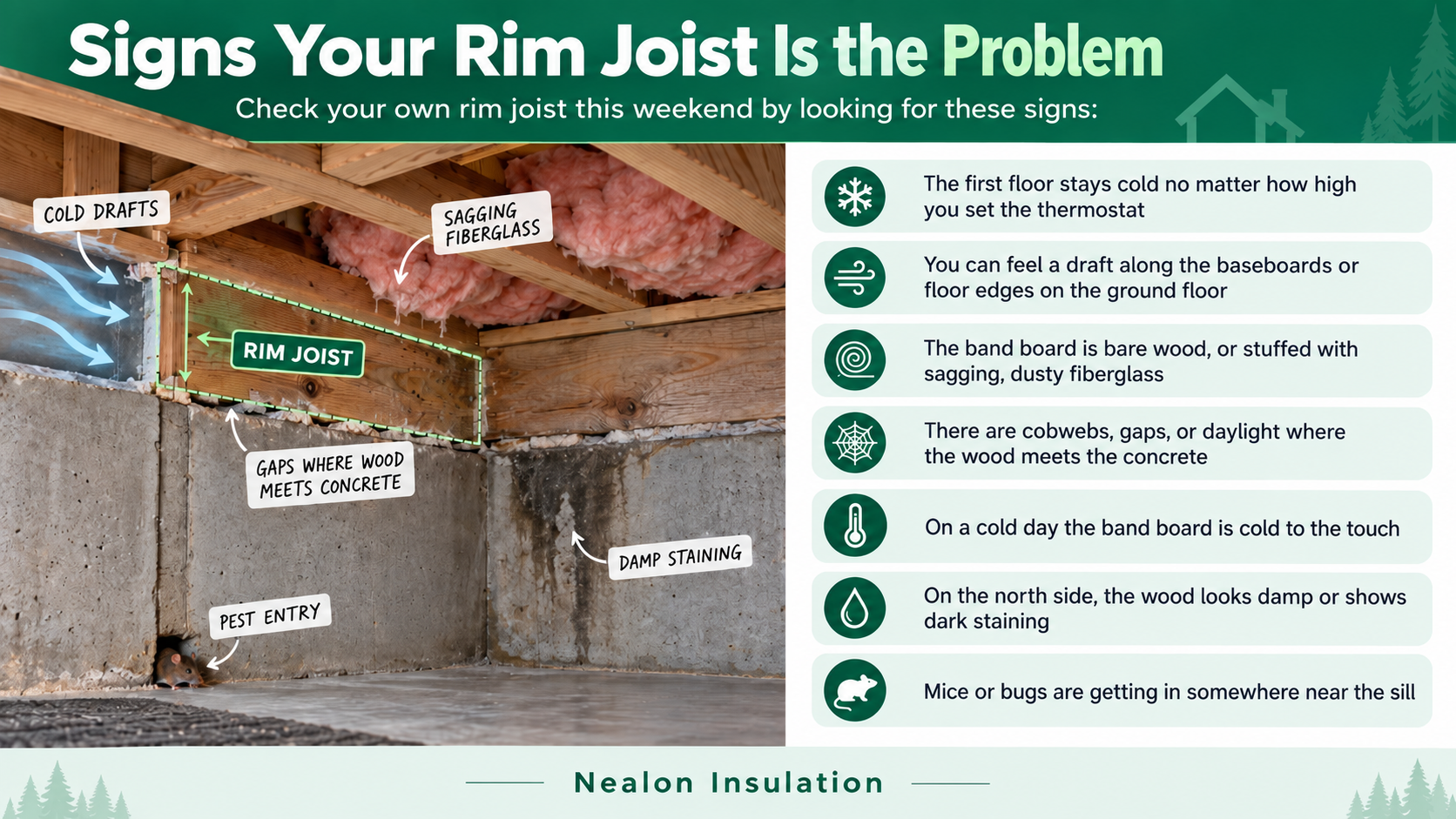
Check your own rim joist this weekend by looking for these signs:
- The first floor stays cold no matter how high you set the thermostat
- You can feel a draft along the baseboards or floor edges on the ground floor
- The band board is bare wood, or stuffed with sagging, dusty fiberglass
- There are cobwebs, gaps, or daylight where the wood meets the concrete
- On a cold day the band board is cold to the touch
- On the north side, the wood looks damp or shows dark staining
- Mice or bugs are getting in somewhere near the sill
One quick test: on a cold day, pull back any fiberglass on the north wall of the basement and look at the lumber behind it. Damp wood, frost, or dark stains mean condensation is already happening.
How to insulate a rim joist: your material options
Three materials do rim joist work in Connecticut: fiberglass, rigid foam board, and closed-cell spray foam. They are not interchangeable, and the differences matter more here than almost anywhere else in the house.
Fiberglass is the cheapest option, but on its own it's the wrong tool at the rim joist for the condensation reason above. If it goes in at all, it can't be the thing doing the air sealing. Rigid foam board works well when you cut it to fit each bay and seal the edges, which also makes it the DIY-friendly choice. Closed-cell spray foam insulation seals and insulates in a single step, fills every gap, and keeps warm air off the wood entirely. To count as an air barrier at the rim joist, closed-cell foam needs to be at least 1.5 inches thick, which is well within a normal application.
Here's the part that surprises people: at the rim joist, closed-cell spray foam lands at or even below the fiberglass price. The usual "spray foam is the expensive option" instinct just doesn't hold in this one spot, because the area is small and the foam does two jobs at once. Energize CT rebates can offset a good chunk of the cost either way, and Nealon's estimate is free.
Here's why closed-cell spray foam is the go-to material for rim joists.
DIY vs. when to call a pro
You can handle a rim joist yourself if the space is open, dry, and easy to reach. The DIY move is to cut a piece of rigid foam board insulation to fit each joist bay, press it tight against the band board, and seal all four edges with a can of spray foam. A weekend, a utility knife, and a couple of cans of foam will do an accessible basement.
Call a pro when you want the whole perimeter done in closed-cell spray foam in one shot, when the basement is finished, when the crawl space is too tight to work in, when old fiberglass has to come out first, or when you find any damp, stained, or soft wood. Moisture or rot means there's a problem to diagnose, not just a bay to fill.
What rim joist insulation costs in Connecticut, and the Energize CT rebate
Rim joist insulation in Connecticut runs $2.30 to $3.00 per square foot for closed-cell spray foam to R-15, and $2.50 to $3.00 per square foot for fiberglass to R-21. Because the rim joist is a small area compared to an attic or a full set of walls, the total is usually one of the more affordable insulation jobs on the whole house.
The rebate makes it easier still. Connecticut insulation rebates through Energize CT cover rim joist work directly, up to $2.00 per square foot or 75% of the project cost, whichever is less, capped at $10,000 per home, when an Energize CT Insulation Installers Network contractor does the install. Nealon is a member. The first step is a Home Energy Solutions audit, which carries a $40 copay and is where the rebate paperwork gets started. The exact number for your house comes from a quick on-site look, and that estimate is free.
See what air sealing a whole house costs in Connecticut.
What to do this weekend
Start with a look and a tape measure before you spend a dollar:
- Go to the basement or crawl space and find the band board along the top of the foundation.
- On a cold day, feel it, and on the north side pull back any fiberglass to check the wood for damp, frost, or dark stains.
- Photograph any wood that looks wet, stained, or soft, so you have a record if it turns out to be rot.
- Measure the length of the run in feet and how deep each joist bay is, so you walk into an estimate with real numbers.
- Book an Energize CT Home Energy Solutions audit, which runs a $40 copay, to kick off the rebate.
Conclusion
The rim joist is a small strip of wood with an outsized effect on how your house feels and how long it lasts. It's where the thermal envelope breaks, where cold first floors come from, and where a Connecticut winter can quietly turn indoor humidity into damp, rotting framing behind a batt of fiberglass nobody ever pulls back to check.
If you fix one overlooked spot in your basement this year, make it the rim joist, and make sure whatever goes in there air-seals, not just insulates. That's the whole difference between a warmer first floor and a rotted band board.
👉 Contact Nealon Insulation — if your floors are cold and your basement's drafty, your rim joist is the first place we'll look.
Frequent Questions About Rim Joist Insulation
How long does it take to insulate a rim joist?
A professional closed-cell spray foam rim joist job takes 4 to 8 hours on an average Connecticut home, and often less if the basement is open and easy to reach. A DIY rigid foam board install takes a weekend for most homeowners. Removing old, moldy fiberglass or working in a tight crawl space adds time, so measure your perimeter first to gauge the scope.
Do I have to remove old fiberglass before insulating the rim joist?
Old fiberglass should come out of the rim joist before new insulation goes in. Fiberglass batts hide moisture and condensation against the wood, and they cannot air-seal the area, so leaving them in place traps the exact problem you are trying to fix. Pull the batts, check the wood for damp or rot, and start clean with rigid foam board or closed-cell spray foam.
Does rim joist insulation need a separate vapor barrier in Connecticut?
Closed-cell spray foam acts as its own air barrier and vapor retarder at the rim joist once it reaches 1.5 inches thick, so no separate vapor barrier is required. Rigid foam board also controls vapor when every edge is sealed with spray foam. Fiberglass on its own does neither, which is why fiberglass is the weakest choice for a Connecticut rim joist.
Will insulating my rim joist actually lower my heating bill?
Insulating the rim joist reduces drafts and cold floors on the level above it, which lets your heating system stop fighting a constant air leak at the foundation line. The dollar savings are modest on their own because the area is small, but the comfort gain on the first floor is large and immediate. Paired with an Energize CT rebate of up to $2.00 per square foot, the payback improves further.
Is rim joist insulation worth it in an older home?
Rim joist insulation is one of the highest-return jobs in an older Connecticut home, because pre-1980 houses were rarely sealed here and the fix is small and affordable. Closed-cell spray foam runs $2.30 to $3.00 per square foot to R-15, and Energize CT rebates cover up to $2.00 per square foot of that. Sealing the rim joist protects the framing from winter condensation while warming the floor above, which makes it a smart early move on any older home.
Related Articles


Let's Work Together
Ready to transform your home into an energy-efficient haven? Schedule your free energy assessment today and experience the Nealon difference for yourself.