
How to Winterize a Beach House: A Connecticut Shoreline Checklist

You lock the cottage in October and don't open it again until May. That's seven months for a pipe to split, for mice to move into the attic insulation, and for the crawl space to soak up damp Long Island Sound air with nobody around to notice. And it's not a niche problem: Old Lyme's town website describes about 8,000 permanent residents plus several thousand seasonal visitors living in summer residences.
In shoreline real estate, "winterized" means two things: a house that's closed up and drained, or one insulated well enough to live in year-round. This checklist covers the first, with a quick look at the second at the end. Most close-up guides stop at the plumbing. The crawl space, the attic, and the critters are what decide what you walk into next spring.
Heat It Low or Drain It Down: Make This Call First
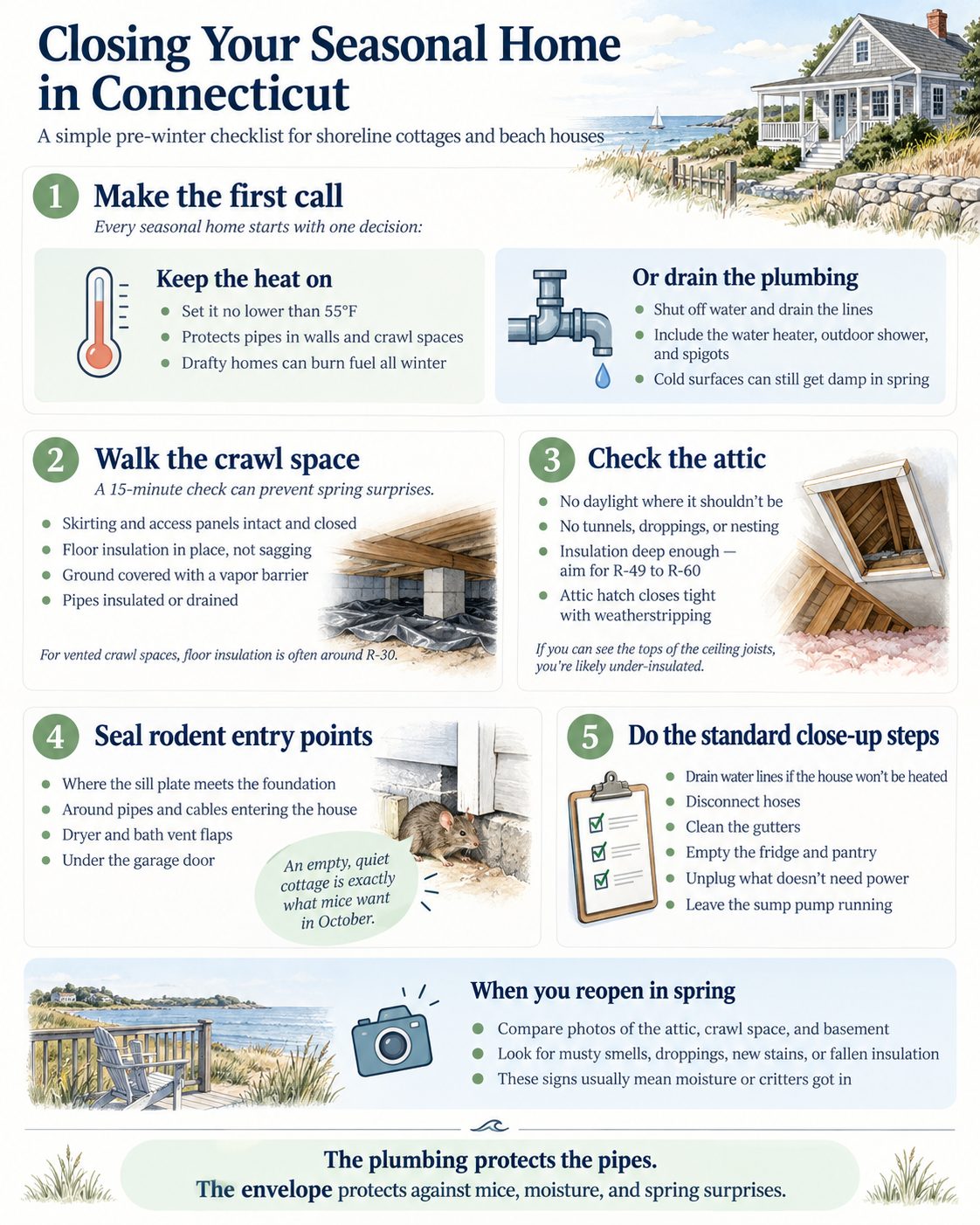
Every seasonal home needs one decision first: keep the heat running low all winter, or shut it off and drain the plumbing. Both work, and both fail in their own way.
If you keep the heat on, don't set it below 55°F, or the pipes in exterior walls and the crawl space are on their own. And your insulation decides the bill: a drafty cottage at 55°F burns fuel all winter to keep empty rooms barely warm.
A drained house isn't moisture-proof either. When the first humid spring days roll in, that damp air condenses on everything that stayed cold all winter: basement walls, crawl space framing, the underside of the floor. That's the musty smell in May.
Why is my house so humid? Causes Connecticut homeowners should know
The Envelope Checklist Most Close-Up Guides Skip
The attic and crawl space take a beating in an empty house, and nobody is there to catch a problem early. Walk both before you leave. It takes about 15 minutes and costs nothing.
Crawl Space and the Underside of the House
Most shoreline cottages sit on a crawl space or piers, and damp salt air is why insulating homes along the Connecticut shoreline is its own animal. Check for:
- Skirting and access panels that are intact and closed, so wind and animals stay out
- Floor insulation that's in place, not sagging or lying on the ground. A vented crawl space needs about R-30 in the floor above it
- A vapor barrier covering the ground, not bare dirt or sand
- Pipes that are insulated, or drained if you're shutting the heat off
Not sure whether your crawl space should be vented at all? That answer decides where the insulation belongs.
Attic
A quick look from the hatch tells you most of what you need.
- Daylight showing anywhere it shouldn't, especially at the eaves
- Tunnels, trails, or droppings in the insulation
- Insulation depth. If you can see the tops of the ceiling joists, you're well under the R-49 to R-60 target, which is roughly 14 to 18 inches of blown-in cellulose
- An attic hatch that closes tight with weatherstripping
Rodent Entry Points
An empty, quiet house with a sheltered crawl space is exactly what a mouse is shopping for in October. Look for gaps where the sill plate meets the foundation, around pipes and cables coming through the walls, at dryer and bath vent flaps, and under the garage door. Here's more on dealing with mice in Connecticut shoreline homes.
Rodent proof insulation: what actually works and what doesn't
The Standard Close-Up Steps
The plumbing and housekeeping basics, short version:
- Shut off the main water and drain the lines, including the water heater, if you're not heating
- Disconnect hoses and drain the outdoor shower and spigots
- Clean the gutters
- Empty the fridge and pantry, and prop the fridge door open
- Unplug what doesn't need power, but leave the sump pump running
Living there full-time? How to winterize your Connecticut home for year-round living
What You Can Handle Yourself and Where a Pro Comes In
Every check in this post is a homeowner job. Walking the attic and crawl space, closing up the plumbing, and weatherstripping the hatch don't need a contractor.
Fixing what you find is different. Insulation that has fallen in a damp crawl space is a symptom of moisture or the wrong material, so stapling it back up fixes the look, not the problem. The pro sequence is find the source, remove what's damaged, seal the entry points, then reinsulate. Skip a step and you end up paying for the job twice.
Thinking About Making It Year-Round?
Turning a summer cottage into a year-round home is mostly an insulation and air sealing job, since a lot of shoreline cottages were built for July, not January.
Ballpark: crawl space insulation typically runs $3.00 to $5.00 per square foot depending on material, and blown-in cellulose in the attic to R-49 runs about $3.00 to $3.50 per square foot. Energize CT rebates can cover up to $2.00 per square foot or 75% of qualifying work, whichever is less, starting with a $40 Home Energy Solutions audit. Confirm a part-time house qualifies when you book. Your exact number comes from a free, no-obligation estimate.
Crawl space vapor barrier: what it is, what it costs, and whether you need one
Your Spring Opening Check
Before you lock up, photograph the attic, crawl space, and basement. In spring, walk the same spots and compare. Look for:
- Droppings or tunnels in the insulation
- A musty smell when you first open the door
- New water stains on ceilings or walls
- Insulation that has dropped out of the crawl space floor
- Rust or frost marks on the roofing nails poking through the attic
Any of these means moisture or critters had the run of the place, and the fix starts with how they got in.
Close It Up Like You Mean It
Closing a beach house for winter comes down to one decision and two walks: heat it or drain it, then check the crawl space and attic before you lock the door. The plumbing keeps the pipes safe. The envelope keeps out the mice, the damp, and the spring surprises.
If you do one thing this week, photograph the attic and crawl space. It's free, takes 15 minutes, and turns next spring's walk-through into a clear comparison.
👉 Contact Nealon Insulation — we'll check the crawl space and attic of your shoreline cottage before winter gets a seven-month head start.
Frequent Questions About Winterizing a Beach House
Can you insulate a summer cottage during the winter?
You can insulate a summer cottage during the winter, because blown-in attic insulation, crawl space insulation, and air sealing do not depend on warm weather. Closed-cell spray foam has minimum surface temperature requirements, so a crawl space in January may need temporary heat before foam goes in. Most Nealon insulation jobs finish in 1 to 2 days. Schedule the work while the cottage sits empty to avoid disrupting the summer season.
Does insulation that mice nested in need to be removed?
Insulation that mice nested in needs to be removed, not covered with new insulation. Mouse nests leave droppings and urine in the insulation, which creates odors and contaminates the material. Insulation removal costs $1.25 to $3.00 per square foot in Connecticut, depending on the material and access. Remove the contaminated insulation, seal the entry points, and then reinsulate to stop the problem from coming back.
Should the crawl space under a beach house be encapsulated?
The crawl space under a beach house should be encapsulated only when the owner wants to bring the crawl space inside the home's thermal and moisture boundary. An encapsulated crawl space gets a sealed vapor barrier and insulated walls at R-15 continuous or R-19 cavity, which keeps damp shoreline air out of the space. A full crawl space encapsulation costs $6,000 to $18,000 depending on scope. Get the crawl space assessed first to confirm whether encapsulation or a vented crawl space with R-30 floor insulation fits the house.
How do I know if my cottage is insulated well enough to live in year-round?
Determine whether a cottage is insulated well enough for year-round living by measuring the attic insulation and checking the walls and floors. A year-round Connecticut home needs R-49 to R-60 in the attic, R-13 to R-21 in the walls, and R-30 in floors over an unheated crawl space. Wall cavities are hidden, so a Home Energy Solutions audit with a blower door test shows where heat escapes for a $40 copay. Book the audit to find air leaks, confirm insulation levels, and qualify for Energize CT rebates.
Will a closed-up beach house get ice dams?
A closed-up beach house gets ice dams only when heat escapes through the attic and melts snow on the roof. A fully drained house with the heat off rarely forms ice dams, because no indoor heat warms the roof deck. A house heated to 55°F with thin attic insulation can still form ice dams at the eaves. Insulate the attic to R-49 to R-60 and seal attic air leaks to keep the roof cold and prevent ice dams.
Related Articles


Let's Work Together
Ready to transform your home into an energy-efficient haven? Schedule your free energy assessment today and experience the Nealon difference for yourself.