
How to Tell If Your Attic Insulation Needs to Be Replaced

Your heating bill keeps climbing. One bedroom is always colder than the rest of the house. You've had the HVAC serviced, you've checked the windows, and nothing obvious is wrong. So what's left?
For a lot of Connecticut homeowners — especially in homes built before 1980 — the answer is sitting right above the ceiling: attic insulation that's past its useful life, quietly underperforming while you pay for it every month.
The problem is that attic insulation fails gradually. It doesn't announce itself. It settles, compresses, absorbs moisture, gets disturbed by pests, or just slowly loses the R-value it was installed with. By the time most homeowners think to look, the insulation has been underperforming for years.
Connecticut's climate doesn't make this any easier. Climate Zone 5A means real winters and humid summers — a combination that accelerates the degradation of certain insulation materials and creates ideal conditions for moisture problems, particularly in shoreline homes. Add in the ice dams that show up on rooflines across the state every January, and the attic becomes one of the most consequential — and most overlooked — systems in the house.
This post walks through exactly what to look for: the visual signs you can check yourself, the symptoms the house will show you, and the two failure modes — moisture and pests — that move replacement from optional to necessary. By the end, you'll know whether your attic insulation deserves a closer look or a full replacement conversation.
Here's a quick video overview if you're a visual learner
How Long Attic Insulation Actually Lasts
Most homeowners assume insulation is a one-and-done deal. You put it in, you forget about it. And for a while, that's mostly true. But insulation doesn't last forever — and in Connecticut, where we're throwing everything at it (cold winters, humid summers, ice dams, the occasional critter), it tends to wear out faster than the national averages suggest.
Here's a general lifespan guide by material:
The number that matters most for Connecticut homeowners isn't the material lifespan — it's the installation date. If your home was built before 1980 and the insulation has never been replaced, there's a good chance it's underperforming — and why remove old insulation matters more than most homeowners realize. Pre-1980 homes were commonly insulated to standards we'd consider inadequate today. Connecticut's current attic guidance runs R-49 to R-60. A lot of older homes are sitting at R-11 or R-19 — sometimes less.
That gap isn't just a number. You feel it every January when the heating bill arrives.
Does old insulation always need to come out, or can you work around it? Read more
The Physical Signs You Can See From the Hatch
You don't need a thermal camera or an energy auditor to spot the obvious stuff. A flashlight and a willingness to stick your head through the attic hatch will tell you a lot.
Here's what to look for:
- Flat or compressed insulation — Fiberglass batts that have been compressed by foot traffic, storage, or just time lose R-value fast. Insulation works by trapping air. Squeeze it flat and it stops doing its job.
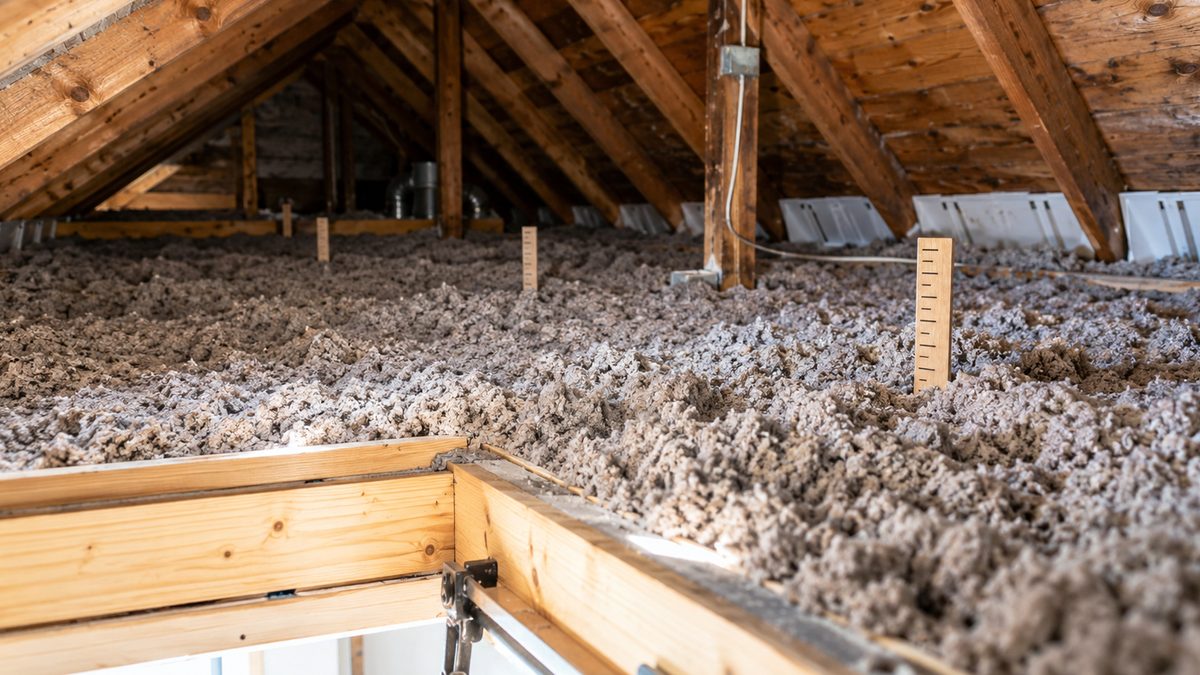
- Thin coverage — If you can see the tops of your attic floor joists poking through the insulation, you're under-insulated. Full stop. At R-49, you should have roughly 16–18 inches of blown-in fiberglass or about 12–13 inches of cellulose. Visible joists mean you're nowhere near that.
- Discoloration or dark streaking — If you see dark or grayish streaking across the insulation — especially near the eaves or along framing — that's often a sign of air bypassing through the insulation rather than through it. It's essentially using your insulation as a filter. That's an air sealing problem as much as an insulation problem.
- Water stains or wet spots — Any discoloration that looks like an old water stain warrants a closer look. Moisture-damaged insulation doesn't bounce back.
- Visible gaps or voids — Missing coverage around recessed lights, pull-down stair openings, or along the eaves is common in older installs. Those gaps are where your conditioned air is escaping.
Signs You Can't See But Definitely Feel
Not every insulation problem announces itself visually. Sometimes the insulation looks fine from the hatch — it's there, it's covering the floor, nothing looks obviously wrong. But the house is telling you something else entirely.
These are the symptoms worth paying attention to:
- Uneven temperatures between floors — If your second floor or top-floor rooms are noticeably colder in winter or hotter in summer than the rest of the house, the attic is usually the first place to look. Heat rises, and if the attic floor isn't holding it in, you're losing it straight through the ceiling.
- Drafts near the ceiling line — Cold air infiltration from a poorly insulated or air-sealed attic often shows up as a subtle draft along the top of walls or near ceiling fixtures. Homeowners usually blame the windows. It's rarely the windows.
- Ice dams along the roofline — Ice dams form when heat escapes through the attic floor, warms the roof deck, melts snow, and that meltwater refreezes at the cold eaves. They're a symptom, not a cause. The cause is almost always inadequate attic insulation combined with poor air sealing.
- Heating and cooling bills that don't make sense — If your energy bills have been climbing and nothing obvious has changed, your insulation's degraded performance is a likely contributor. Connecticut energy costs are already among the highest in the country. Underperforming insulation makes that worse every single month.
None of these symptoms are definitive on their own. But if two or three are showing up at the same time, the attic is worth a serious look.
If ice dams are showing up every winter, here's what's actually causing them — and how insulation fixes it. Read more
Moisture and Pest Damage — The Two That Force Replacement
There's a difference between insulation that's old and insulation that's compromised. Age alone doesn't always mean replacement — sometimes a top-off is enough. But moisture damage and pest activity are different. When either of those is in the picture, you're not topping off. You're starting over.
Moisture damage
Insulation and water don't mix. Fiberglass batts that get wet lose their ability to trap air — the very thing that makes them work. They mat down, stay compressed, and become a hospitable environment for mold. Cellulose is even more vulnerable. It absorbs moisture readily, compacts under the weight, and if conditions are right, it will grow mold faster than you'd expect.
The tricky part is that moisture damage isn't always obvious from a quick visual scan. You might see staining on the insulation or the sheathing above it. You might smell something musty when you open the hatch. Or you might not notice anything until a contractor pulls back a section and finds the problem underneath.
For Connecticut shoreline homeowners, this is a real and recurring issue. High humidity in summer, condensation during seasonal transitions, and any history of roof leaks or ice dam damage all create conditions where moisture gets into the insulation assembly. We've written about attic moisture buildup and what proper remediation actually looks like — it's worth a read if you've had any roof leaks or ice dam history. Once moisture gets in, the insulation isn't just underperforming — it may be actively contributing to a moisture and air quality problem in the home.
Pest damage
Rodents love attic insulation. It's warm, it's soft, and it's undisturbed. Mice and squirrels tunnel through batts, shred material for nesting, and leave behind waste that contaminates the entire assembly. Beyond the obvious hygiene concern, pest-damaged insulation has voids, compressed sections, and gaps that destroy its thermal performance.
Signs of pest activity include:
- Droppings on top of or mixed into the insulation
- Shredded or clumped material that looks disturbed
- Nesting areas — usually in corners or along eaves
- Entry points visible along the roofline or soffits
If you find evidence of pests, the insulation needs to come out. There's no remediation shortcut that makes contaminated insulation safe or functional again. The space needs to be cleaned, any entry points sealed, and the insulation replaced from scratch.
Dealing with rodents in the attic? Here's how we handle full insulation removal and replacement after a pest infestation. Read more
R-Value Loss — When Insulation Is There But Not Working
This is the one that catches people off guard. The insulation is present. It's covering the attic floor. Nothing looks obviously wrong. But the house is still uncomfortable, the bills are still high, and something isn't adding up.
The answer is often R-value loss — and it's more common than most homeowners realize.
What settling does to blown-in insulation
Blown-in insulation — whether fiberglass or cellulose — settles over time. That's just physics. Cellulose is particularly prone to it, sometimes losing 20% or more of its installed depth within the first few years, and continuing to compact slowly after that. Since R-value is directly tied to thickness and density, a settled insulation layer is a less effective one. An attic that was installed to R-38 fifteen years ago might be performing closer to R-28 today.
That's a meaningful gap — especially measured against Connecticut's current guidance of R-49 to R-60 for attics.
How to spot R-value loss without a thermal camera
You don't need specialized equipment to get a rough read on this. A tape measure will do.
- Locate the depth markers installed by the original contractor, if they exist — they look like small cardboard rulers stapled to the joists
- Measure the current depth of the insulation in a few spots across the attic floor
- Cross-reference with the R-value per inch for your insulation type: blown-in fiberglass runs about R-2.5 per inch, cellulose runs about R-3.5 per inch
Topping off vs. full replacement
Not every case of R-value loss requires a full tear-out. If the existing insulation is dry, uncontaminated, and structurally intact — just thin — adding a layer on top is often a reasonable solution. It's less disruptive and less expensive than starting from scratch.
But topping off only makes sense when the foundation underneath is sound. If there's moisture damage, pest contamination, or the existing material is so compressed it's essentially a mat on the floor, adding more insulation on top doesn't fix the problem. It buries it.
A good contractor will tell you which situation you're actually in — not just default to the more expensive option.
Not sure how much R-value you actually need in Connecticut? Here's how to figure it out. Read more
What to Do If You're Not Sure
Here's the honest answer: most homeowners aren't sure. And that's completely reasonable. Attic insulation isn't something you look at regularly, the failure modes are subtle, and the consequences — higher bills, uncomfortable rooms, moisture problems — are easy to attribute to something else.
If you've read through the signs above and you're still on the fence, here's a practical path forward.
Do a basic self-assessment first
You don't need to hire anyone to take a first look. Grab a flashlight, open the attic hatch, and check for the obvious stuff — insulation depth, visible compression, staining, or any sign of moisture or pests. If something looks clearly wrong, you have your answer. If everything looks passable but the house still isn't performing, that's worth a professional set of eyes.
Get a professional assessment
A qualified insulation contractor will look at things a homeowner can't easily evaluate — air sealing deficiencies, thermal bypasses, moisture readings, and whether the existing material is worth building on or needs to come out. A contractor worth hiring will tell you what you actually need, not just what costs the most.
If you want an independent data point before calling a contractor, an energy auditor using a blower door test and thermal imaging can pinpoint exactly where your home is losing conditioned air. It's a useful step for older homes where the problems aren't always obvious from a visual inspection alone.
Check what rebates are available
Energize CT rebates are available for qualifying insulation and air sealing work. Depending on the scope of the project, those rebates can meaningfully offset the cost. A contractor familiar with the program can help you understand what's eligible before any work begins.
The bottom line: if your home is more than 20 years old and the attic has never been assessed, that's the starting point. Not a full replacement necessarily — just an honest look at what's up there and whether it's still doing its job. Sometimes a top-off is all it takes. Sometimes the right call is starting fresh. Either way, you're better off knowing.
The Bottom Line
Attic insulation doesn't fail all at once. It's a slow decline — a little more settling each year, a little more R-value lost, a little more of your heating budget disappearing through the ceiling. The frustrating part is that most homeowners don't connect the symptoms to the source until someone actually looks up there.
The good news is that the signs are readable if you know what to look for. Compressed or thin insulation, visible joists, dark streaking, ice dams, uneven temperatures, moisture staining, pest activity — none of these are subtle once you know what they mean. And R-value loss, even when the insulation looks intact, is something a tape measure and a quick calculation can surface pretty quickly.
If your home is more than 20 years old and the attic has never been assessed, that's the starting point. Not a full replacement necessarily — just an honest look at what's up there and whether it's still doing its job. Sometimes a top-off is all it takes. Sometimes the right call is starting fresh. Either way, you're better off knowing.
Connecticut homeowners have access to Energize CT rebates that can help offset the cost of qualifying insulation upgrades — another reason not to put the conversation off.
👉 Contact Nealon Insulation if you're seeing any of these warning signs — we'll take an honest look at what's going on in your attic and tell you exactly what it needs.
Frequent Questions About Signs Attic Insulation Needs to Be Replaced
How much does it cost to replace attic insulation in Connecticut?
The cost to replace attic insulation in Connecticut typically ranges from $1,500 to $4,500 for an average-sized attic, depending on the size of the space, the insulation material being removed, and what's going in as a replacement. If there's significant moisture remediation or pest cleanup involved, that adds to the total. The good news is that Energize CT rebates are available for qualifying projects, which can offset a meaningful portion of the cost. The best way to get an accurate number is a site visit — attic conditions vary enough that ballpark estimates over the phone aren't worth much.
Can I just add insulation on top of the old stuff instead of replacing it?
Sometimes, yes. If the existing insulation is dry, uncontaminated, and just thin, adding a layer on top is a legitimate and cost-effective solution. But it only works when the foundation underneath is sound. If the existing material has moisture damage, mold, or pest contamination, adding new insulation on top doesn't fix anything — it just covers the problem while it continues to get worse underneath. A contractor should assess the existing conditions before recommending a top-off versus a full replacement.
How do I know if my attic insulation has mold?
Mold in attic insulation isn't always visible from a casual inspection. The most common indicators are a musty smell when you open the hatch, visible dark staining on the insulation or the roof sheathing above it, and a history of roof leaks or ice dam damage. Cellulose insulation is particularly prone to mold because it absorbs moisture readily. If you suspect mold, don't disturb the insulation — have a contractor assess it properly. In some cases, air quality testing may be warranted before any removal work begins.
Does old attic insulation contain asbestos?
It depends on when and how the home was insulated. Homes insulated before the late 1970s have a higher likelihood of containing asbestos-containing materials, particularly if vermiculite insulation was used — a loose, pebble-like gray material that was commonly used during that era and has been linked to asbestos contamination. Standard fiberglass batts and cellulose from that period are generally not asbestos risks, but vermiculite is a different story. If your home was built before 1980 and you're not sure what's up there, have the material tested before anyone disturbs it. Removal of asbestos-containing insulation requires licensed abatement contractors and is handled separately from standard insulation replacement.
How long does attic insulation replacement take?
For a typical Connecticut home, attic insulation replacement takes one to two days. Removal of the old material is usually done first — either by hand or with a commercial vacuum system — followed by any necessary air sealing work, and then installation of the new insulation. If there's additional remediation involved, such as mold treatment or structural repairs, the timeline extends accordingly. Most straightforward replacement projects are a one-day job for an experienced crew.
Related Articles
Let's Work Together
Ready to transform your home into an energy-efficient haven? Schedule your free energy assessment today and experience the Nealon difference for yourself.