
Why Heating Bills Increase When Temperatures Drop
Every winter in Connecticut, the same pattern shows up on utility bills. A stretch of mild weather keeps heating costs manageable… and then a cold snap rolls in. Suddenly the furnace seems to run nonstop, and the next energy bill jumps higher than expected.
That’s not a coincidence.
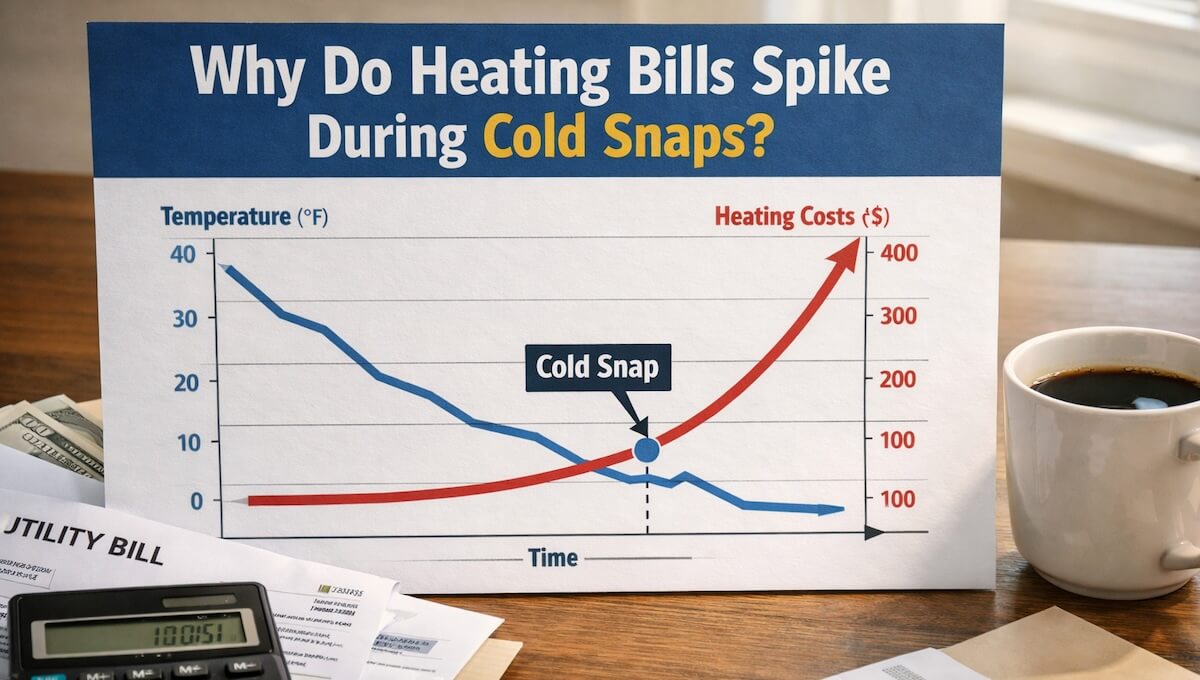
Heating costs are closely tied to outdoor temperatures. When the weather gets colder—especially during sharp temperature drops—homes lose heat faster. Your heating system has to work longer and harder to maintain indoor comfort, which increases energy use and drives up monthly bills.
In this article, we’ll look at the relationship between Connecticut weather and heating costs, explain why cold snaps cause heating bills to spike, and show why some homes see much bigger increases than others.
Why Heating Bills Increase When Temperatures Drop
Heating bills rise in winter for a simple reason: heat naturally moves from warm areas to cold ones.
When it’s warm inside your home and cold outside, heat is constantly trying to escape through:
- The attic
- Exterior walls
- Windows and doors
- Small air leaks around the home
The colder it gets outdoors, the faster this heat loss happens.

Think of your home like a bucket filled with warm water. If the bucket has holes in it, water slowly leaks out. When temperatures drop, those “holes” effectively get bigger because the temperature difference between inside and outside increases.
Your heating system then has to keep adding more heat to replace what’s being lost.
This is why heating demand rises as temperatures fall.
At 45°F outside, your heating system may only run occasionally. But when temperatures drop into the teens or single digits during a cold snap, your system may run almost continuously.
That’s why homeowners often notice a sudden jump in Connecticut winter heating bills during the coldest weeks of the year.
The best insulation for exterior walls.
What Happens to Energy Use During a Cold Snap
A cold snap is a short period of unusually cold weather, often when temperatures drop well below the seasonal average for several days.
In Connecticut, these events typically occur in January or February and can push temperatures into the teens or single digits.
When a cold snap hits, two things happen quickly.
Homes Lose Heat Much Faster
The bigger the difference between indoor temperature (typically 68–70°F) and outdoor temperature, the faster heat escapes.
If the outdoor temperature drops from 35°F to 10°F, the temperature difference nearly doubles. That means your home is losing heat much more quickly.
Heating Systems Run Much Longer
Instead of cycling on and off throughout the day, heating systems may run nearly nonstop to keep indoor temperatures comfortable.
During extreme cold, energy use rises sharply across entire regions. Utilities often see their highest demand of the year during cold snaps, which is why many homeowners see their largest heating bills after the coldest weeks of winter.
Can Better Insulation Reduce My Heating Bill in Winter?
The Role of Heating Degree Days (HDD)
Energy experts use a measurement called Heating Degree Days (HDD) to understand how weather affects heating demand.
Heating Degree Days measure how much heating is required based on outdoor temperature.
The calculation works like this:
Heating Degree Days = 65°F − Average Outdoor Temperature
For example:
The colder the day, the higher the number of Heating Degree Days—and the more energy a home typically needs to stay warm.
Over the course of a winter, these numbers add up. A mild week might produce relatively few heating degree days, while a week-long cold snap can generate a large spike.
That spike usually shows up in the form of higher energy use and larger heating bills.
Why Some Connecticut Homes See Much Higher Heating Bills
Two homes can sit on the same street, experience the same weather, and still have very different heating bills.
The difference usually comes down to how well each home holds onto heat.
When temperatures drop, homes lose heat through the building envelope, which includes:
- The attic
- Exterior walls
- Windows and doors
- Floors and foundations
- Small air leaks throughout the structure
Homes that are well insulated slow this heat loss. Homes that are poorly insulated lose heat much faster.
Several factors can dramatically influence heating costs:
- Attic insulation levels – Heat rises, so poorly insulated attics allow large amounts of heat to escape.
- Air leaks – Small gaps around attic penetrations, framing joints, and ductwork allow warm air to escape and cold air to enter.
- Home age – Many Connecticut homes were built before modern insulation standards existed.
- Heating system efficiency – Older systems may run longer and consume more fuel.
Because of these factors, two homes facing the same 10°F outdoor temperature can experience very different heating demand.
A well-insulated home may maintain comfort with moderate heating use, while a poorly insulated home may struggle to keep up, causing the heating system to run almost constantly.
What are the Different Types of Blown-In Insulation?
Why Cold Snaps Hit Older Homes the Hardest
Cold snaps tend to expose weaknesses in a home’s insulation and air sealing—and older homes usually have more of those weaknesses.
Connecticut has one of the oldest housing stocks in the country, and many homes were built before modern insulation codes existed.
Common issues in older homes include:
- Thin attic insulation
- Air leaks around attic penetrations and framing
- Settled or compressed insulation
- Gaps around plumbing and wiring
During mild weather these problems may go unnoticed. But during extreme cold, they can significantly increase heat loss.
Older homes often experience:
- Faster heat loss
- Longer furnace run times
- Larger swings in indoor temperature
- Higher winter energy bills
This is why homeowners in older Connecticut homes often see the largest heating bill spikes during the coldest weeks of winter.
How to insulate a historic home in Connecticut.
How Better Insulation Stabilizes Heating Bills
If cold weather increases heating demand, the best way to control heating costs is to slow down how quickly your home loses heat.
That’s exactly what insulation and air sealing do.
Insulation creates a barrier that reduces heat transfer through the attic, walls, and floors. Instead of heat escaping rapidly into the cold outdoor air, insulation helps keep warmth inside the home.
Air sealing addresses another major source of heat loss—small air leaks.
Sealing gaps around attic penetrations, ductwork, and framing joints prevents heated air from escaping and cold air from entering the home.
When insulation and air sealing work together, they help create a more stable indoor environment.
Benefits include:
- Slower heat loss
- Shorter furnace run times
- More consistent indoor temperatures
- Lower winter energy costs
- Reduced heating bill spikes during cold snaps
For many Connecticut homeowners, attic insulation upgrades and air sealing are among the most effective ways to control winter heating costs.
What does it cost to air seal a house?
The Key Takeaway: Cold Weather Drives Heating Bills — But Home Efficiency Determines How Much
Connecticut winters naturally increase heating costs. When outdoor temperatures drop, homes lose heat faster and heating systems must run longer to maintain comfortable indoor temperatures.
Cold snaps amplify this effect because the temperature difference between inside and outside becomes much larger.
But while weather drives heating demand, home efficiency determines how much your heating bill increases.
Homes with good insulation and proper air sealing lose heat more slowly, which means heating systems don’t have to run as often—even during extreme cold.
Homes with poor insulation and air leaks lose heat quickly, forcing heating systems to work much harder.
You can’t control Connecticut’s winter weather, but you can control how well your home holds onto heat.
👉 Contact Nealon Insulation to reduce your energy bills today!
FAQs about Heating Bills
How do I know if poor insulation is causing my heating bills to spike?
Poor insulation often causes high heating bills by allowing heat to escape through attics, walls, floors, and air leaks. Common signs include uneven room temperatures, constant furnace cycling, cold exterior walls, and drafts near ceilings or attic access points. A professional insulation evaluation measures insulation depth, identifies air leakage, and confirms whether insulation upgrades can reduce winter heating costs.
How much can attic insulation actually reduce heating bills?
Upgrading attic insulation can reduce heating and cooling energy use by 10% to 30% depending on existing insulation levels, air leakage, and home age. Proper attic insulation slows heat loss through the roof, reduces furnace runtime, and stabilizes indoor temperatures. Combining insulation upgrades with attic air sealing produces the largest reduction in winter heating costs.
What is the most cost-effective upgrade to reduce heating bills in Connecticut homes?
Attic air sealing combined with upgraded attic insulation is the most cost-effective way to reduce heating bills in Connecticut homes. Air sealing blocks warm indoor air from escaping through attic penetrations, while insulation slows heat transfer through the ceiling. Addressing attic heat loss first delivers the highest energy savings and fastest return on investment during winter.
How long does it take to upgrade insulation in an attic?
Most attic insulation upgrades take one day to complete depending on attic size, accessibility, and preparation requirements. Contractors typically air seal attic penetrations, improve ventilation if necessary, and install blown-in insulation to reach recommended levels such as R-38 to R-60. The process creates minimal disruption compared to larger home renovation projects.
When is the best time of year to upgrade insulation to lower heating bills?
Upgrade insulation in early fall before winter temperatures increase heating demand and energy loss. Fall insulation upgrades prepare the home for colder weather by reducing heat transfer and improving indoor comfort. Winter installations still lower heating costs immediately, while spring upgrades improve energy efficiency for both summer cooling and the following winter.
Related Articles
Let's Work Together
Ready to transform your home into an energy-efficient haven? Schedule your free energy assessment today and experience the Nealon difference for yourself.