
Why Home Improvement Estimates Are Wrong (And Why Ours Aren’t)
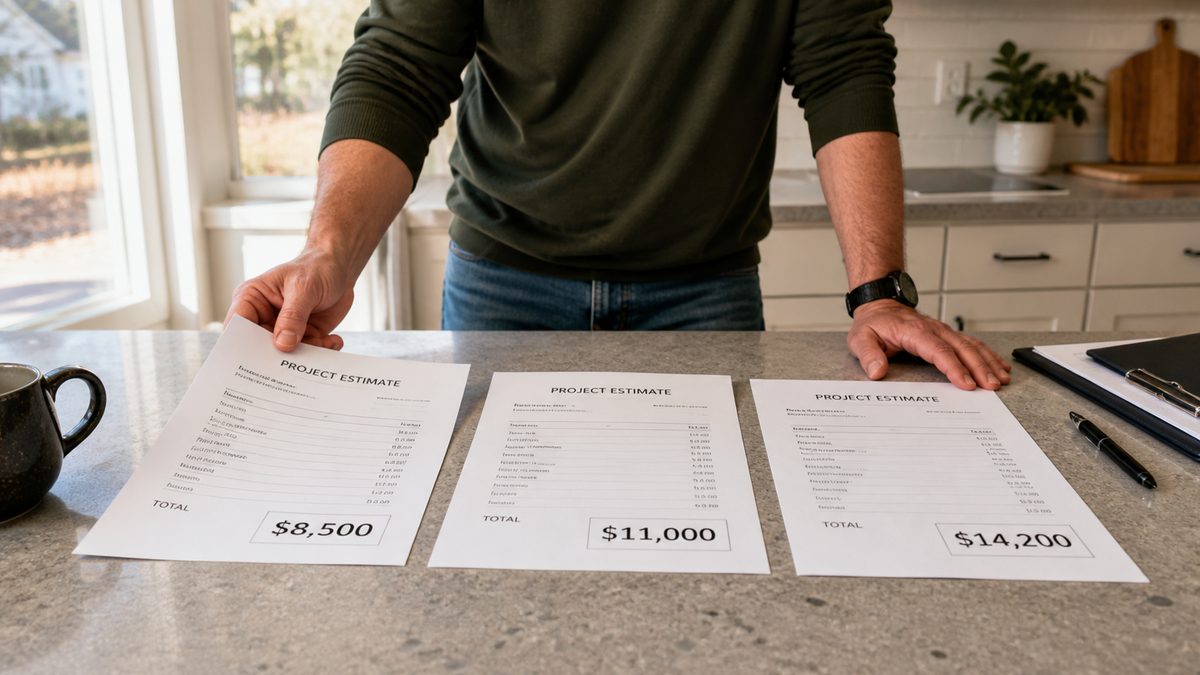
You called three contractors. They came out, walked around, nodded knowingly, and sent you numbers. One quoted $8,500. One quoted $14,200. One quoted $11,000. Same house, same job, three completely different answers. Which one do you trust?
This is one of the most common and most frustrating experiences in home improvement. And it’s not unique to Connecticut — it’s not even unique to construction. Oxford professor Bent Flyvbjerg spent decades studying why projects of every size go over budget and over schedule. His research, compiled in How Big Things Get Done, found that 92% of major projects come in over budget, over time, or both. His conclusion was blunt: most projects don’t go wrong during the work. They start wrong, because of bad estimates and wishful thinking built in from the very beginning.
That dynamic plays out in living rooms and attics across Connecticut every single day. A homeowner gets a quote, feels reasonably confident, signs the contract — and then watches the number climb once the work is underway and there’s no practical way to stop it.
We’ve been insulating Connecticut homes since 1977. In that time, we’ve seen every version of this problem. We’ve also figured out how to avoid it. Our estimates are accurate 99.9% of the time. The number we give you for the agreed scope of work is the number you’re going to pay.
This post is about why estimates go wrong, what a reliable one actually looks like, and how to tell the difference before you sign anything.
The Numbers Don’t Lie — Most Projects Go Over Budget
Here’s a number that should make every homeowner pause: according to research by Oxford professor Bent Flyvbjerg, who spent decades studying thousands of projects across industries, 92% of major projects come in over budget, over schedule, or both. His book How Big Things Get Done is mostly about megaprojects — bridges, tunnels, the Olympics. But he’s quick to point out that home renovations follow the exact same pattern.
He uses a real example in the book: a couple buys a run-down house and gets a builder to quote the full renovation. The number comes back at $260,000. Reasonable, they think. Eighteen months later, they’ve spent $1.3 million — and the project still isn’t done. That’s not a typo. Five times over budget, and counting.
Now, that’s an extreme case. But the underlying dynamic — an estimate that doesn’t survive first contact with reality — is something homeowners deal with every single day, at every price point.
Flyvbjerg calls this the “iron law of megaprojects”: over budget, over time, under benefits, over and over again. What’s striking is that this law doesn’t care about the size of the job. A kitchen remodel in Madison, a bathroom gut in Branford, an attic insulation project in Old Saybrook — all of them are vulnerable to the same forces that blow up billion-dollar construction programs.
The difference is scale, not the underlying problem.
Want to know what insulation actually costs before you call anyone?
Why Estimates Go Wrong
Bad estimates don’t happen by accident. There are specific, repeatable reasons why the number a contractor puts in front of you in week one bears no resemblance to the invoice you get in week twelve. Most of them come down to psychology, incentives, and a lack of real diagnostic work upfront.
Optimism Bias — Contractors (and Homeowners) Want to Believe
Flyvbjerg identifies optimism bias as one of the single biggest drivers of cost overruns in projects of every size. It’s the deeply human tendency to believe that this project will go smoothly, that the materials will arrive on time, that there won’t be any surprises behind the walls, and that everything will cost roughly what it’s supposed to cost.
Contractors aren’t immune to this. Neither are homeowners. In fact, both parties often want the low number to be true. The homeowner wants the project to be affordable. The contractor wants to win the job. So the estimate gets built on best-case assumptions — and reality has a way of making you pay for that optimism later.
The “Think Fast, Act Slow” Trap
Flyvbjerg’s research on why projects fail points to a pattern he calls “think fast, act slow” — where people rush into decisions and commitments before they’ve done the real planning, then spend months or years dealing with the fallout. He uses the Sydney Opera House as a textbook example: construction started before the design was even finished, costs spiraled to 1,400% over budget, and crews had to demolish significant sections of work that couldn’t be salvaged.
Home projects fall into the same trap constantly. A contractor does a 20-minute walkthrough, punches out a number, and the homeowner signs before anyone has really thought through what the job requires. Flyvbjerg puts it plainly: projects don’t go wrong so much as they start wrong.
Scope Creep and the “While We’re at It” Problem
This one is almost universal in home improvement. The job starts as an attic insulation project. Then someone opens up the eaves and finds the soffit has been rotting for a decade. Then there’s a wasp nest. Then the homeowner says, “well, while you’re up there…” and suddenly the scope has doubled.
Some of this is genuinely unpredictable — older Connecticut homes in particular have a talent for hiding problems until you open something up. But a lot of scope creep is the result of insufficient diagnosis at the start. If the contractor doesn’t know what’s up there before quoting, they’re not giving you a real estimate. They’re giving you a starting bid.
Strategic Underbidding — The Low Number That Wins the Job
This one is less flattering to the industry, but it’s real. Flyvbjerg calls it “strategic misrepresentation” — when a contractor knowingly presents an optimistic number to win a contract, with the understanding that costs will be negotiated upward once the work is underway and the homeowner has no practical way out.
It’s not always malicious. Sometimes it’s borderline unconscious. But the incentive structure makes it common: the contractor who bids $12,000 gets the job over the one who bids $17,500, even if the $17,500 number is the accurate one. If you’re not sure how to evaluate competing bids, our guide on how to compare two insulation quotes walks through exactly what to look for. The homeowner finds out the truth after demo has started and there’s nowhere else to turn.
What a Good Estimate Actually Looks Like
An accurate estimate isn’t magic. It’s the result of doing the real diagnostic work before anyone puts a number on paper. The contractors who get it right aren’t guessing better than everyone else — they’re guessing less. They’ve replaced assumptions with actual information.
Knowing the Job Before You Quote It
A proper estimate starts with a proper assessment. That means getting eyes on the actual conditions — not just a quick visual from the hatch opening, but a real look at what’s up there, what’s down there, and what the house is actually dealing with.
For insulation work specifically, that means checking existing R-values, looking for air bypasses, noting moisture conditions, identifying pest activity, and understanding the existing ventilation setup. Every one of those factors can change the scope, the materials, and the labor involved. Skip any of them and you’re not estimating — you’re ballparking.
Flyvbjerg makes the point that most projects don’t go wrong during execution. They start wrong because of poor planning. The assessment phase is where estimates are made or broken, and it doesn’t get the attention it deserves in most of the industry. If you want to see exactly how that process works, we broke it down in how we build an insulation estimate.
Experience as a Forecasting Tool
One of the most useful ideas in How Big Things Get Done is what Flyvbjerg calls “reference class forecasting.” The concept is straightforward: instead of treating every project as completely unique, look at it as one of a type. What does a job like this typically involve? What surprises show up in houses like this one? What does it actually cost when all is said and done?
Experienced contractors do this naturally, even if they don’t have a name for it. After hundreds of attic insulation jobs in Connecticut homes built between 1940 and 1980, you start to know what you’re going to find before you climb the ladder. Knob-and-tube wiring tucked into the joists. Vermiculite sitting in the corners. Baffles that were never installed. Soffit vents blocked with decades of insulation drift.
That accumulated knowledge is what makes an estimate reliable. Not optimism. Not a low number designed to win the bid. Pattern recognition built from real field experience.
Honest Scoping Up Front
The third piece is transparency about what the job actually includes. A reliable estimate spells out the scope in plain language: what’s being done, what’s not being done, what materials are being used, and what conditions could change the picture.
If there’s a known unknown — say, we won’t know the exact condition of the sheathing until we pull back some insulation — that gets flagged upfront, not discovered on day three and turned into a change order.
Homeowners deserve to know what they’re agreeing to. A good contractor makes that possible. A contractor who’s deliberately vague about scope is leaving themselves room to charge you more later. It’s that simple.
Curious how to price an insulation job the right way? Here’s how contractors actually build a number.
Why Our Estimates Hold
We’ve been doing this since 1977. That’s not a credential we throw around to sound impressive — it’s the actual reason our estimates are accurate. Nearly five decades of insulation work across Connecticut homes means we’ve seen the inside of thousands of attics, crawl spaces, basements, and wall cavities. We know what’s in there before we open the hatch.
Flyvbjerg’s research makes a point that resonates with how we work: the contractors who get estimates right aren’t smarter than everyone else. They’re more experienced. They treat each job not as a unique puzzle but as one of a type — and they draw on everything they’ve learned from similar jobs to build a realistic picture of what this one will actually cost.
That’s exactly what we do.
We Assess Before We Quote
We don’t do 20-minute walkthroughs followed by a ballpark. Before we put a number in front of you, we look at the actual conditions — existing insulation depth and R-value, air sealing deficiencies, moisture indicators, ventilation setup, pest activity, and anything else that could affect the scope or the materials. That information goes into the estimate. Not assumptions. Not best-case scenarios.
If something changes that picture after work begins — a genuinely hidden condition that no assessment could have caught — we tell you about it immediately, explain what it means, and discuss next steps before anyone does anything. What we don’t do is quietly expand scope and present a surprise invoice at the end.
We Know What Connecticut Homes Are Hiding
Connecticut’s older housing stock has a personality. Pre-1980 homes in particular tend to have a specific set of characteristics that affect insulation work: inadequate soffit baffling, blocked eave vents, older vapor barriers that were never the right product for the application, knob-and-tube wiring that complicates attic insulation installation, and — especially on the shoreline — moisture damage that’s been quietly accumulating for years.
We’ve seen all of it. Repeatedly. That pattern recognition is built into every estimate we produce. When we quote a 1960s Cape in Madison or a 1950s ranch in Guilford, we’re not guessing at what we’ll find. We’re drawing on hundreds of jobs in houses exactly like it.
The Number We Give You Is the Number You Pay
This is the part that matters most. Our estimates are accurate 99.9% of the time. The price we put in front of you for the agreed scope of work is the price you’re going to pay. Full stop.
That’s not a marketing claim. It’s how we’ve stayed in business in the same communities for going on 50 years. Contractors who lowball bids and walk homeowners into surprise invoices don’t get referrals. They don’t get repeat calls. And in Connecticut’s tight-knit shoreline communities, word travels fast.
We’d rather be the contractor you call again — and the one you recommend to your neighbor — than the one who won the bid and torched the relationship.
Wondering how to check if your contractor is registered and insured in Connecticut before you sign anything?
What This Means for You as a Homeowner
Getting a good estimate starts before you ever pick up the phone. Knowing what to look for — and what to watch out for — puts you in a much stronger position when contractors start showing up at your door with clipboards.
How to Read a Quote
A reliable estimate isn’t just a single number on a piece of paper. It should tell you what’s being done, where, with what materials, and under what conditions. If you can’t answer those questions by reading the estimate, that’s not an estimate — it’s a placeholder designed to get a foot in the door.
Look for:
- A clear description of the scope, broken down by area (attic, walls, basement, etc.)
- Specific materials called out by name and R-value, not just “blown-in insulation” with no further detail
- Labor and materials separated or at least explained
- Any stated assumptions — what the price is based on, and what could change it
- A defined process for how scope changes are handled if something unexpected turns up
If the quote is one line and a number, ask for more. A contractor who can’t explain what they’re pricing isn’t ready to do the job.
Red Flags That Signal a Shaky Estimate
Some warning signs are easy to spot, others less so. Here’s what should give you pause:
- The estimate comes back within an hour of the site visit, with no follow-up questions
- The number is significantly lower than every other quote you received
- There’s no mention of existing conditions, current insulation levels, or moisture
- The contractor can’t tell you what product they’re installing or why
- Vague language like “as needed” or “allowance included” without explanation
- No written scope of work — just a verbal agreement
Flyvbjerg’s research points to something he calls “strategic misrepresentation” — the tendency to present an optimistic number to win the job, with the understanding that costs will climb once work is underway. The homeowner is in a difficult position at that point: demo has started, they’ve signed a contract, and switching contractors mid-job is expensive and disruptive. Before you get to that point, it’s worth reading our list of 10 smart questions to ask before hiring an insulation contractor.
Why the Lowest Bid Often Costs the Most
This isn’t a cliché — it’s arithmetic. When a contractor underestimates a job by 30% to win the bid, that gap has to come from somewhere. It comes from change orders. It comes from “unforeseen conditions” that a more thorough assessment would have caught. It comes from shortcuts in materials or labor that you may not notice for a year or two, but that your energy bills and moisture readings absolutely will.
The contractor who bids accurately and loses the job to a lowballer isn’t losing because they don’t know how to do the work. They’re losing because they were honest about what the work actually costs. That’s the contractor worth finding.
Not sure how to find the right insulation contractor in Connecticut? Here’s where to start.
The Bottom Line on Estimates
Getting a home improvement estimate right isn’t complicated in theory. You assess the actual conditions, draw on real experience, scope the job honestly, and stand behind the number you give. What makes it hard in practice is that the incentives in this industry often push in the opposite direction — toward the low number that wins the bid, toward optimism over accuracy, toward vague language that leaves room to charge more later.
Flyvbjerg’s research found that the projects that come in on budget share a common thread: they were planned slowly and carefully before anyone picked up a tool. The ones that blow up were rushed into execution before anyone really understood what the job required.
That’s as true for a Connecticut attic project as it is for a billion-dollar tunnel.
We’ve been doing this long enough to know what it takes to get the number right. That means a real assessment before we quote, honest scoping of what’s included, and a price that holds for the work we agreed to do. No surprise invoices. No change orders for things we should have caught during the walkthrough.
When we give you a number, that’s the number. That’s the standard we hold ourselves to, and it’s the standard you deserve from any contractor you hire.
Frequent Questions About Home Improvement Estimates
How do I know if a contractor’s estimate is actually accurate before I hire them?
Check a contractor’s estimate by comparing at least three detailed, written estimates for the same scope of work. Verify labor, material quantities, product specifications, permits, taxes, subcontractor costs, and contingency allowances. Investigate unusually high or low prices, confirm licensing and insurance, and require written explanations for allowances or exclusions before hiring.
Why are my three quotes so different from each other for the same job?
Three contractor quotes can differ because each contractor may calculate labor, materials, overhead, profit, allowances, and project risks differently. Quotes may also cover different scopes of work or material grades. Compare each quote line by line and confirm that quantities, specifications, exclusions, warranties, permits, and completion requirements match.
What should I do if a contractor wants to charge me more than the original estimate once work has started?
Ask the contractor for a written explanation before agreeing to charges above the original estimate. Compare the additional costs with your contract, estimate, and approved change orders. Confirm whether unforeseen conditions or requested changes justify the increase. Do not approve additional work until the contractor documents the new scope, price, and payment terms.
Does a higher estimate always mean better quality work?
"A higher contractor estimate does not always mean better quality work. Higher prices can reflect premium materials, experienced labor, stronger warranties, higher overhead, or a larger scope of work. Compare material specifications, labor, warranties, exclusions, references, licensing, and project scope instead of using price alone to judge quality."
How long does an accurate insulation estimate take, and what should the process look like?
An accurate insulation estimate typically requires a 30–90 minute on-site inspection, depending on the building’s size and complexity. The contractor should measure insulation areas, inspect existing insulation, identify air leaks and moisture problems, determine the required insulation type and R-value, calculate material and labor costs, and provide a detailed written estimate.
👉 Contact Nealon Insulation — Get an estimate you can actually count on, from a team that’s been getting it right since 1977.
Related Articles
Let's Work Together
Ready to transform your home into an energy-efficient haven? Schedule your free energy assessment today and experience the Nealon difference for yourself.