
Vapor Barrier vs. Crawl Space Encapsulation: What's the Difference?
Every August, the same thing happens in a lot of Connecticut homes. The floors upstairs feel a little clammy, a musty smell shows up from nowhere, and when you finally poke your head into the crawl space you find it dark, damp, and smelling like a wet basement. So you start calling around, and now you've got two quotes sitting on the kitchen table: one for a “vapor barrier” and one for “crawl space encapsulation,” with a price gap big enough to make you wonder if somebody's pulling your leg.
Here's the straight version, from someone who has crawled under a lot of shoreline houses. A vapor barrier and crawl space encapsulation are not two names for the same job. One is a single component. The other is a whole system that happens to include that component. In Connecticut's climate, with humid summers and older homes sitting over vented dirt-floor crawl spaces, the gap between them is the gap between “sort of dry” and “actually dry.” Let's break down what each one really is, and how to tell which one your house needs.
What a Vapor Barrier Actually Is
A vapor barrier is a single layer of plastic laid over your crawl space floor to block moisture from rising out of the soil. It's usually 6-mil polyethylene sheeting, rolled across the dirt, overlapped at the seams, and sometimes tucked up the walls a few inches. That's the whole thing. A basic vapor barrier installation stops there: the foundation vents stay open, the walls stay mostly bare, and the sheet isn't closed into a sealed system.
Its one job is to stop ground moisture from evaporating up into the wood and air above it, and for that one job, it works. What a bare vapor barrier does not do is touch the humid outdoor air pouring in through your open foundation vents. It doesn't control the humidity in the space, and it doesn't seal out drafts or pests. Think of it as a tarp on the mud, not a lid on the box. If your only moisture problem is the soil breathing water vapor upward, a vapor barrier handles it. If your problem is bigger than that, a bare barrier is going to leave you disappointed.
What Crawl Space Encapsulation Actually Is
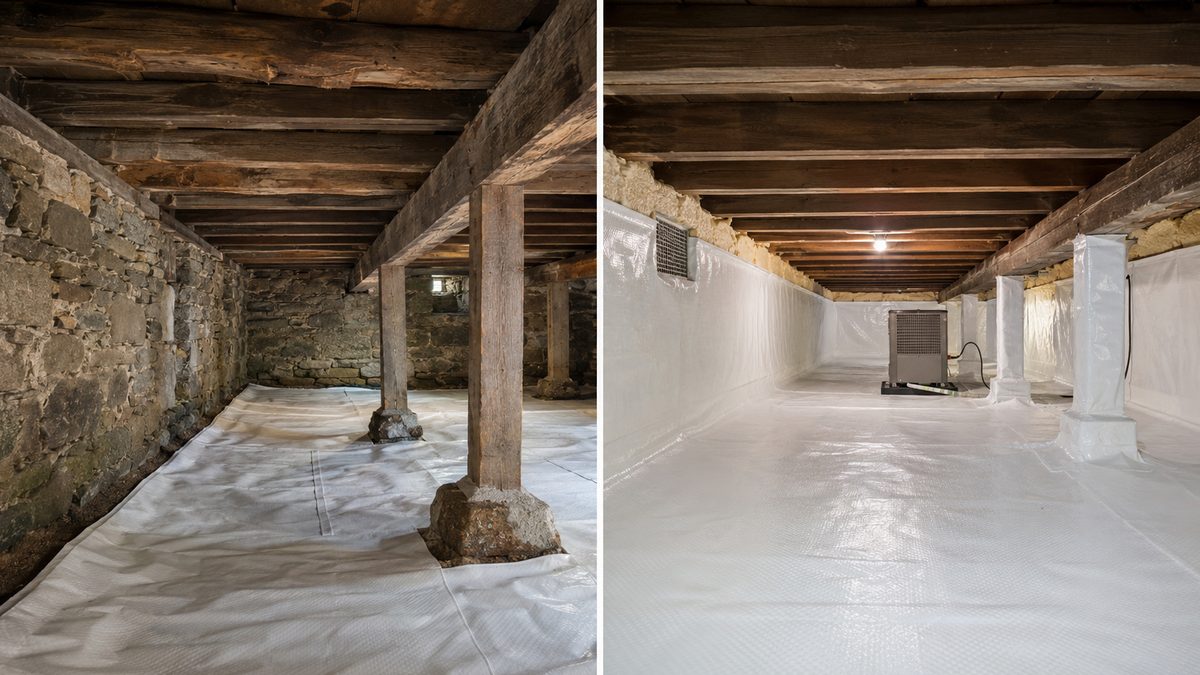
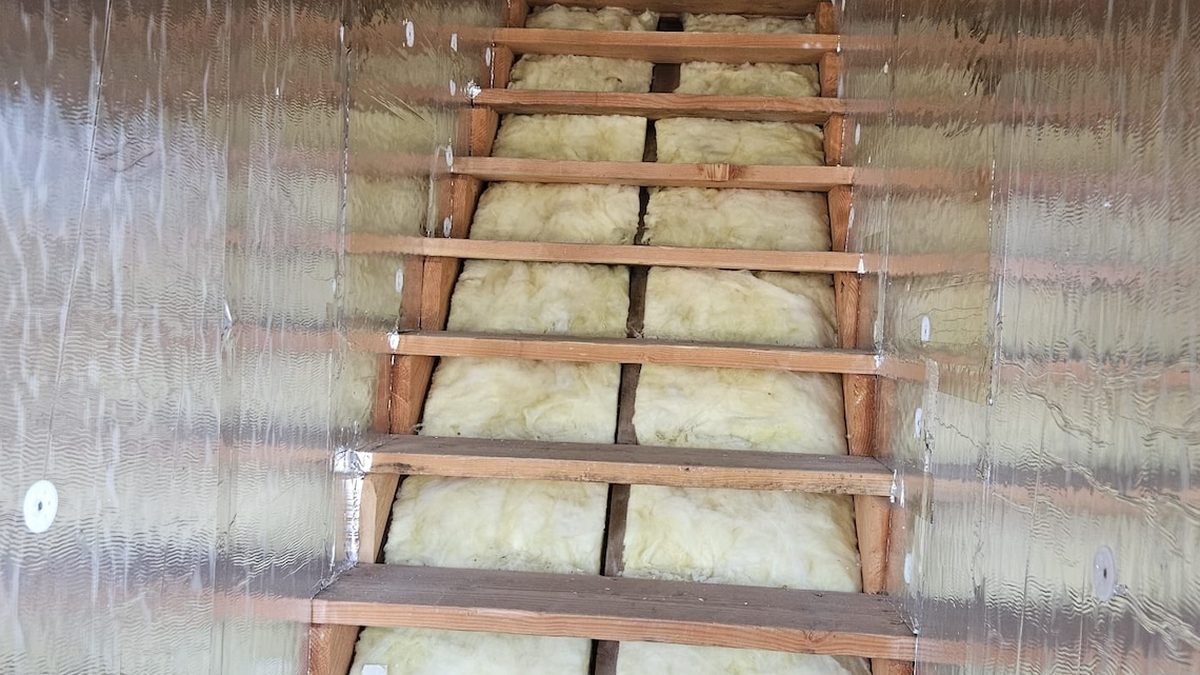
Crawl space encapsulation is a complete sealing system that closes the crawl space off from the ground, the outside air, and the weather. It starts with a much heavier liner, usually 12 to 20 mil, that covers the floor and runs up the foundation walls. The seams get taped, the liner gets fastened to the walls, the foundation vents get sealed shut, and in most cases a dehumidifier goes in to keep the air dry year round. Sometimes crawl space insulation gets added to the walls or the floor above, depending on the house.
When it's done, that dark, damp crawl space becomes a clean, dry, sealed room that's part of your home's conditioned envelope. (A sealed or closed crawl space and an encapsulated crawl space are the same thing.) If a vapor barrier is a rain tarp thrown over the mud, encapsulation is a full raincoat with the zipper done up, the hood on, and the cuffs cinched. One keeps the ground from wicking up. The other controls the whole environment.
See exactly what a full crawl space encapsulation system includes, start to finish.
The Real Difference (And Why It Matters in Connecticut)
The real difference is scope: a vapor barrier is one part of an encapsulation system, but encapsulation is far more than a vapor barrier. Here's why that matters so much in our climate. Connecticut summers are humid, and a vented crawl space pulls that humid outdoor air straight in through the foundation vents. When that warm, moist air hits the cooler surfaces under your house, the framing, the ductwork, the pipes, it drops its moisture as condensation. A bare floor vapor barrier does nothing about that, because the water isn't coming from the soil anymore. It's riding in on the summer air.
This isn't a sales pitch, it's measured building science. A Department of Energy field study that compared vented crawl spaces with sealed ones found that the sealed crawl spaces stayed substantially drier through humid conditions, while the vented ones tracked right along with the muggy outdoor air. That study was run in the humid Southeast, but the mechanism is the same one that soaks Connecticut crawl spaces every July and August. Sealing the vents, which is what encapsulation does and a bare vapor barrier does not, is what breaks the cycle.
Wondering whether those foundation vents should be open at all? Here's the CT answer on whether you should vent your crawl space.
When a Vapor Barrier Alone Is Enough
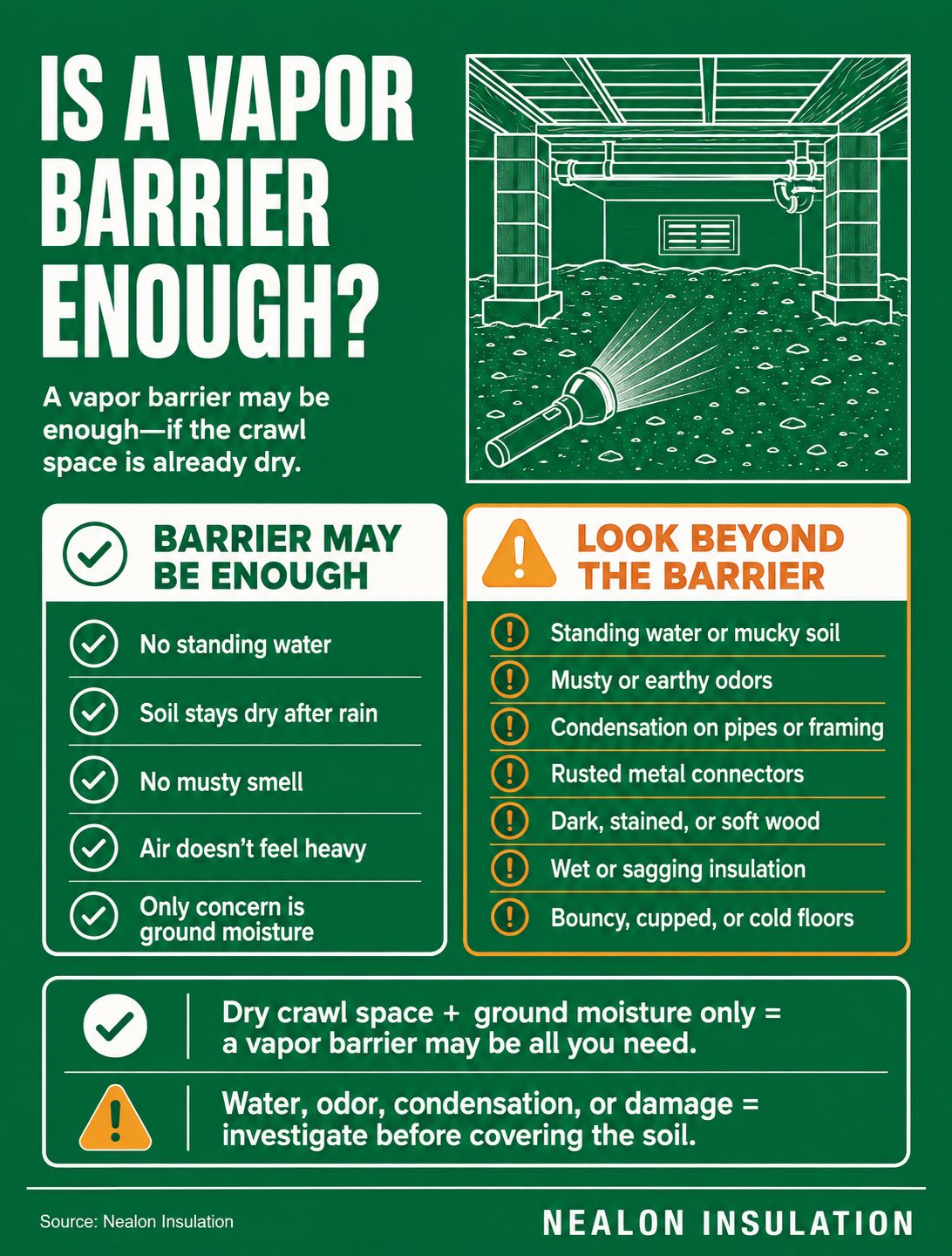
A vapor barrier alone is enough when your crawl space is already dry and your only concern is ground moisture. Plenty of contractors won't tell you this, because encapsulation is the bigger ticket. But it's the truth: if your crawl space stays dry, has no standing water, doesn't smell musty, and the air down there isn't heavy, a good vapor barrier over the soil may be all you need. Not every crawl space is a swamp, and not every house needs a five-figure system.
The trick is knowing which camp your crawl space is in, and that's something you can check yourself this weekend. Head down there with a flashlight and look for the signs that a bare vapor barrier won't be enough:
- Standing water, or damp, mucky soil after it rains
- A musty, earthy smell you also notice in the living space above
- Condensation or water droplets on the ductwork, pipes, or framing
- Rusty nail heads, duct straps, or metal connectors
- Wood that looks dark or stained, or feels soft
- Insulation that's sagging, falling down, or matted with moisture
- Floors above the crawl space that feel bouncy, cupped, or cold
Two quick tests tell you a lot. First, tape a two-foot square of clear plastic flat against the dirt overnight. If the underside is beaded with water in the morning, your soil is pushing moisture up, and you at least need a vapor barrier. Second, drop a cheap hygrometer down there for a day and read the humidity. If it sits above 60%, you've got an air problem a floor liner won't solve, and you're into encapsulation territory.
Here's the honest DIY line. Laying a basic vapor barrier over a dry, accessible dirt floor is a legitimate weekend project if you don't mind the crawl. Roll it out, overlap and tape the seams, and you've handled ground moisture. Full encapsulation is not a DIY job. Sealing the walls and vents correctly, clearing existing moisture before you seal it in, and sizing a dehumidifier are where things go wrong fast, and a botched seal can make moisture worse by locking it in. That part earns a pro.
Before you call anyone, do three things: run the plastic and hygrometer tests, take a few photos of anything that looks wet or rusty, and if you want a full read on the whole house, book an Energize CT Home Energy Solutions audit. You'll walk into any contractor conversation knowing whether you're shopping for a liner or a system.
Once the space is sealed, the next question is what to line it with. Here's the best crawl space insulation material for Connecticut homes.
So Which One Does Your Crawl Space Need?
Choose a vapor barrier for a dry crawl space with a soil-moisture problem, and choose encapsulation for a crawl space that's humid, musty, or wet. The comparison table above lays the two side by side, but the decision usually comes down to one question: is your problem the ground, or the air? Ground-only problems are a vapor barrier's whole reason to exist. Air and humidity problems need the vents sealed and the space dried out, which is what crawl space encapsulation is built to do.
In Connecticut, older shoreline homes with open vents and swampy summer crawl spaces land in the encapsulation column more often than not, but there's no reason to spend on a system your house doesn't need. On cost, expect a real gap. A basic vapor barrier is a modest job, while full encapsulation is a significant investment that scales with the size of the crawl space, the thickness of the liner, and whether a dehumidifier and drainage are part of the plan. The table above gives you the ranges. Whatever you're quoted, make sure you know exactly which one you're buying, because “we'll put down a vapor barrier” and “we'll encapsulate” are very different lines on an invoice.
Curious what a fully sealed crawl space does for the rest of the house? See how encapsulation upgrades the whole home.
Conclusion
So the short version is this. A vapor barrier is a single component that stops moisture from rising out of the soil, and it's the right call for a crawl space that's already dry. Crawl space encapsulation is a full system that seals the floor, walls, and vents and controls the air, and it's what a damp, humid, or musty crawl space needs. Encapsulation includes a vapor barrier. A vapor barrier is not encapsulation.
Don't let anyone talk you into a five-figure system for a crawl space that just needs a liner, and don't waste money tarping over a space that's soaking wet from the summer air. Go look, run the two tests, and match the fix to the actual problem. That's how you spend your money once instead of twice.
👉 Contact Nealon Insulation — if your crawl space is damp, musty, or you just want a straight answer on whether you need a liner or the full system, we'll come take a look.
Frequent Questions About Crawl Space Vapor Barriers and Encapsulation
How long does crawl space encapsulation take to install?
Crawl space encapsulation takes 1 to 3 days for most Connecticut homes, depending on the crawl space size and how much prep the space needs. A clean, dry crawl space installs faster than one that needs old insulation removed, standing water addressed, or mold treated first. Larger crawl spaces and added features like a dehumidifier or interior drainage extend the timeline. Clear out stored items and fix active leaks before installation to keep the job on schedule and the cost predictable.
How thick should a crawl space vapor barrier be?
A crawl space vapor barrier should be at least 6 mil thick for a basic floor covering, and 12 to 20 mil for a full encapsulation liner. Thicker liners resist tears and punctures from foot traffic and stored items, which matters in any crawl space a person will ever enter. A 6 mil sheet handles ground moisture on the floor, but it's too thin to run up walls or stand up to heavy use. Choose a 12 mil or thicker reinforced liner for any crawl space you plan to seal, insulate, or use, to protect the barrier and extend its life.
Does crawl space encapsulation qualify for Energize CT rebates?
Crawl space encapsulation is not directly covered by Energize CT rebates, but the crawl space insulation and air sealing done alongside it can qualify. Energize CT insulation rebates pay up to $2.00 per square foot or 75% of the project cost, capped at $10,000, for qualifying insulation installed by a network contractor. The vapor barrier liner and the dehumidifier themselves fall outside the rebate. Book an Energize CT Home Energy Solutions audit, which carries a $40 copay, to find out which parts of your project qualify before you sign anything.
Does crawl space encapsulation get rid of a musty smell in the house?
Crawl space encapsulation removes a musty smell in the house when the odor comes from crawl space moisture, which it usually does. Damp crawl space air rises into the living space through the stack effect, carrying mold and mildew odors with it. Sealing the crawl space and holding its humidity below 60% stops the mold growth that creates the smell at its source. Encapsulate the crawl space and run a dehumidifier to clear the odor, improve indoor air quality, and protect the framing above.
How long does crawl space encapsulation last?
Crawl space encapsulation lasts 15 to 25 years for the liner, and often longer when the space stays sealed and maintained. A quality 12 to 20 mil reinforced liner resists tears, punctures, and rot far better than a thin 6 mil sheet. The dehumidifier is the shorter-lived part and may need service or replacement within 8 to 12 years. Check the liner seams and the dehumidifier once a year to catch small issues early, protect the seal, and get the full lifespan out of the system.
Related Articles

Let's Work Together
Ready to transform your home into an energy-efficient haven? Schedule your free energy assessment today and experience the Nealon difference for yourself.