
Crawl Space Insulation: What You Need to Know (CT Guide)
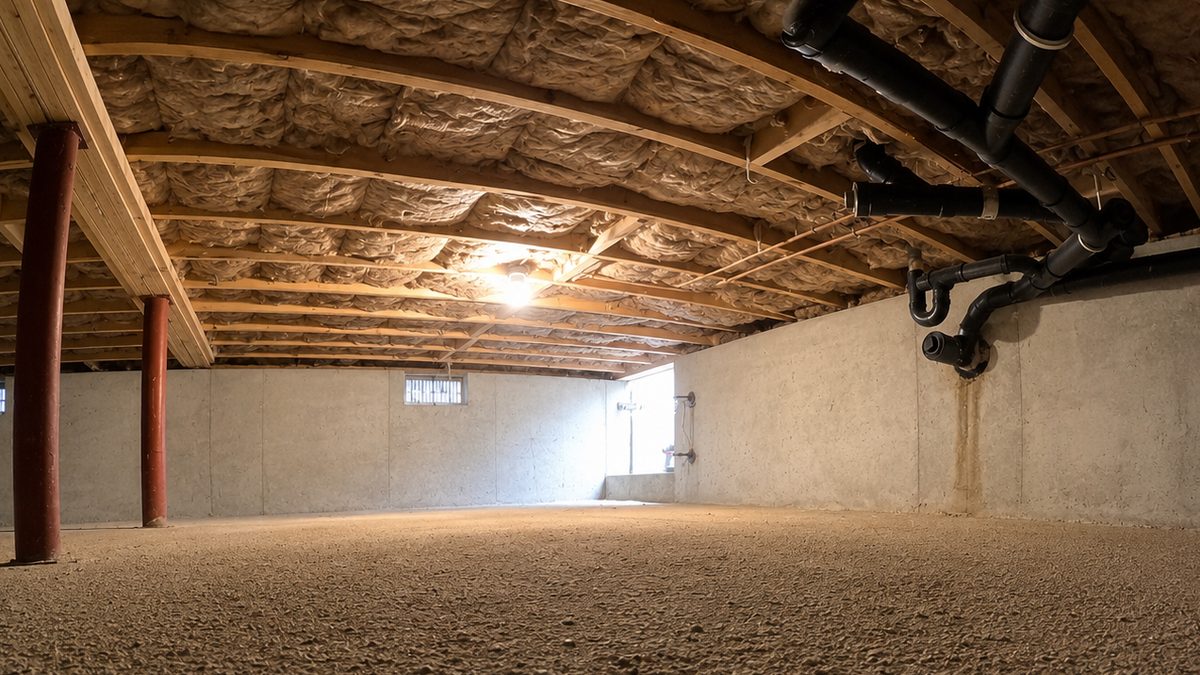
Your floors are cold in January even with the heat cranked. The air upstairs feels swampy in July no matter how hard the AC works. And every so often you catch a musty smell that seems to come from nowhere. Nine times out of ten in Connecticut, the culprit is sitting right under your feet: an unfinished, under-insulated crawl space that is doing nothing to help you.
Crawl spaces are the most ignored part of a Connecticut home, and they punish you for ignoring them. In a Zone 5A climate with freezing winters and sticky, humid summers, that dirt-floored gap under your house is either working for you or working against you. This guide covers what crawl space insulation actually does, whether to insulate the floor or the walls, the R-value your home needs, what the job costs here, and how to tell if your crawl space is overdue for attention.
Why Your Crawl Space Is Costing You Money
An uninsulated crawl space bleeds heat and comfort out of the rooms above it. In winter, the floor over that crawl space sits directly above outdoor-temperature air, so your feet feel it first and your furnace works overtime to make up the difference. The floor system is a huge surface area, and a cold crawl space turns all of it into a heat leak.
It gets worse than a high heating bill. Air in a house moves upward, a phenomenon called the stack effect. Warm air rises and escapes through the attic, and to replace it, the house pulls air in from the lowest point it can reach, which is your crawl space. Whatever is down there, damp air, mold spores, musty odor, or radon, gets drawn up into your living space and into the air you breathe. So the crawl space is not a separate zone you can ignore. It is the bottom of your lungs.
Vented vs. Unvented: The Fork in the Road
Connecticut homeowners face one real decision with a crawl space: insulate the floor and leave the space vented, or seal the space, condition it, and insulate the walls. For decades, building codes required foundation vents on the theory that outside airflow would keep the crawl space dry. In our climate, that theory falls apart every summer.
Here is the mechanism, and it is the part most national guides skip. Dew point is the temperature at which air starts dropping its moisture as condensation. In Connecticut, average dew points swing from the low 20s Fahrenheit in midwinter to the low 60s at the peak of summer, roughly a 40-degree gap between January and July. When you open a foundation vent in July, you are inviting warm, moisture-heavy outdoor air into a crawl space where the ground and framing are still cool. That humid air hits the cooler surfaces and condenses, exactly the way a glass of iced tea sweats on a porch. The vent that was supposed to dry the space out is soaking it instead.
That is why the honest answer to venting depends on your specific crawl space, and it is worth reading our full breakdown on whether to vent or seal your crawl space before you commit to either path. If your crawl space is dry and stays dry, insulating the floor of a vented space can work. If you have any moisture history, sealing the space and insulating the walls is almost always the better long-term move in Connecticut.
What sealing a crawl space actually involves, and when a ground vapor barrier alone is not enough
What R-Value Do You Actually Need in Connecticut?
Connecticut crawl spaces call for R-19 to R-30 when you insulate the floor, and roughly R-15 of continuous rigid foam when you insulate the foundation walls of a sealed space. R-value measures resistance to heat flow, and higher is better up to the point of diminishing returns. Because we sit in Climate Zone 5A, our targets run higher than what a contractor in Virginia or the Carolinas would quote you, which is one reason generic national advice steers people wrong here.
The right number depends on which approach you take, floor insulation versus wall insulation. The table below lays out the Connecticut target for each.
Do not overthink hitting an exact number to the decimal. The bigger mistakes are leaving gaps, compressing the insulation, which quietly kills its R-value, or blocking foundation vents in a space that still needs them.
How much insulation Connecticut homes actually need, area by area
Insulation Materials, in Plain English
Three materials do almost all the real work in a crawl space, and each has a job it is actually good at. Picking the wrong one is how homeowners end up ripping insulation back out two years later.
- Closed-cell spray foam is the strongest all-around option for a sealed crawl space. It insulates and air-seals in one pass, and it does not absorb water, so it holds up in the damp conditions crawl spaces are prone to. It costs more per square foot, and it is a pro-only install.
- Rigid foam board is the standard for insulating foundation walls in a sealed crawl space. It resists moisture, and the seams get taped to form a continuous barrier.
- Fiberglass batts are the cheapest option and the most misused. In a dry, vented crawl space, batts between the floor joists can work. In a damp one, they soak up moisture like a sponge, sag, lose their R-value, and turn into a mold habitat. If your crawl space has any moisture at all, batts are the wrong call.
For the full comparison of what holds up and what fails down there, see our guide to the best crawl space insulation material. And if your crawl space is already wet or musty, insulation alone will not fix it. The real solution is sealing the space first, which is work for experienced crawl space encapsulation contractors, then insulating the walls once it is dry.
Why blown-in insulation is the wrong material for a damp crawl space
How Much Does Crawl Space Insulation Cost in Connecticut?
Most crawl space insulation projects in Connecticut run between $2,000 and $8,000, and a full seal-and-insulate encapsulation project runs $6,000 to $18,000 depending on scope. That is a wide range on purpose, because the condition of your crawl space drives the price more than the square footage does. A clean, dry space is cheap to insulate. One with old wet batts to remove, mold to treat, or standing water to drain costs more before any new insulation goes in.
The variables that move the number:
- Size of the crawl space and how accessible it is to work in
- Removal of old, wet, or moldy insulation before new material goes in
- Moisture repairs like a vapor barrier, drainage, or a dehumidifier
- Material chosen: batts on the low end, spray foam on the high end
The good news is that Connecticut helps pay for it. Through Connecticut insulation rebates under the Energize CT program, professional insulation work qualifies for up to $2.00 per square foot or 75% of the project cost, whichever is less, capped at $10,000 per home. The one requirement is a Home Energy Solutions audit first, which carries a $40 copay and is where your rebate paperwork gets started. On a crawl space job, that rebate can knock a real dent in the total.
Estimate what your Energize CT insulation rebate could be worth
Signs Your Crawl Space Needs Attention
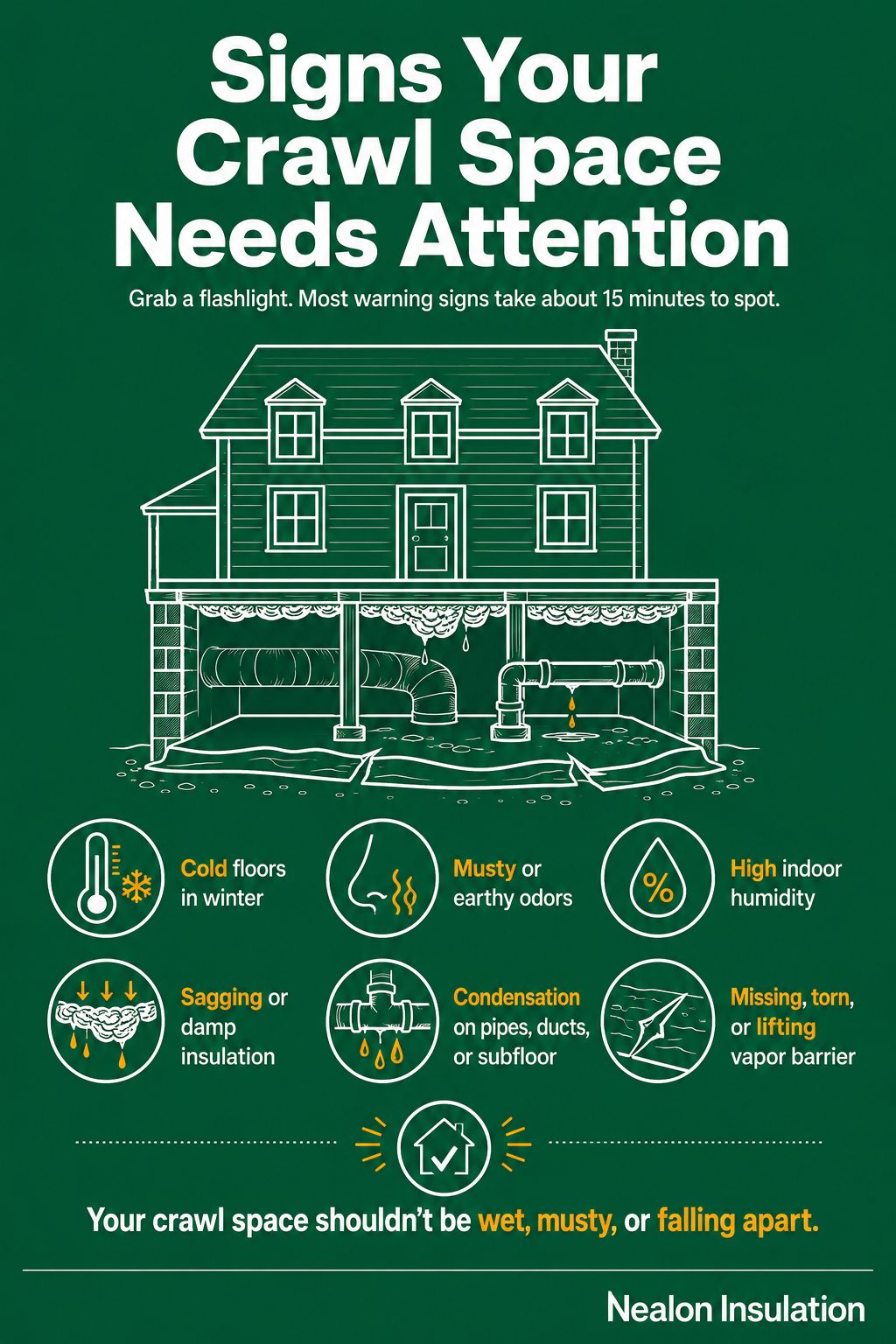
You can diagnose most crawl space problems yourself in about fifteen minutes with a flashlight. Look and sniff for these signs:
- Floors above the crawl space feel cold in winter no matter how high you set the thermostat
- A musty or earthy smell drifts up into the rooms above, especially in summer
- The house feels humid upstairs even with the AC running
- Insulation between the joists is sagging, falling down, or visibly dark and damp
- You see condensation or water droplets on ductwork, pipes, or the underside of the subfloor
- The dirt floor has no plastic vapor barrier over it, or the barrier is torn and lifting
If you spot two or more of these, your crawl space is working against you. Snap a few photos while you are down there so you have a record of what it looked like and where the problem areas are.
DIY or Call a Pro?
You can handle the diagnostic and some of the simpler work yourself, but the moisture-critical parts belong to a professional. Laying a ground vapor barrier over a dry dirt floor and installing fiberglass batts between joists in an accessible, dry crawl space are reasonable weekend jobs for a capable homeowner.
Everything moisture-related crosses the line into pro territory. Sealing the space, installing spray foam or taped rigid foam on the walls, treating existing mold, and addressing water intrusion all require the right equipment and experience, and mistakes down there are expensive to fix after the fact. A good rule: if the crawl space is dry and you are only insulating the floor, you can likely start yourself. If there is any moisture, get an assessment first. Either way, your best free next step is scheduling a Home Energy Solutions audit, which gives you a professional read on the whole house and opens the door to the rebate.
Conclusion
A crawl space is the easiest part of a Connecticut home to ignore and one of the most expensive to keep ignoring. Whether you insulate the floor of a vented space or seal and insulate the walls of a conditioned one, the payoff shows up in warmer floors, lower bills, drier air, and a house that stops pulling musty air up from below.
Start by going down there with a flashlight this weekend and checking for the signs above. If your crawl space is dry, you may be able to tackle the floor insulation yourself. If it is damp, musty, or you are not sure, an audit will tell you exactly what it needs before you spend a dollar on materials.
👉 Contact Nealon Insulation — if your crawl space is overdue for an honest look, we will tell you exactly what it needs and what it does not.
Frequent Questions About Crawl Space Insulation
How much does it cost to insulate a crawl space in Connecticut?
Crawl space insulation in Connecticut typically costs between $2,000 and $8,000, while a full seal-and-insulate encapsulation project runs $6,000 to $18,000. The single biggest cost driver is the condition of the space, not its size. Removing old wet insulation, treating mold, or fixing water intrusion all add cost before new insulation goes in. Energize CT rebates can offset up to $2.00 per square foot of the professional work.
Does crawl space insulation qualify for Energize CT rebates?
Yes, professionally installed crawl space insulation qualifies for Energize CT rebates. The program covers up to $2.00 per square foot or 75% of the project cost, whichever is less, capped at $10,000 per home. You must complete a Home Energy Solutions audit first, which has a $40 copay and is where the rebate application is issued. The work has to be done by a contractor in the Energize CT Insulation Installers Network, which Nealon is a member of.
Do you have to remove the old insulation before installing new insulation?
You have to remove old insulation if it is wet, moldy, or falling down, which is common in Connecticut crawl spaces. Dry, intact insulation can sometimes stay in place and be supplemented, but damp fiberglass batts have already lost their R-value and become a mold risk, so they come out. Removal usually adds a few hundred dollars to a project, and it is not a step worth skipping to save money.
How long does a crawl space insulation job take?
Most crawl space insulation jobs take one to three days. A straightforward floor insulation job in a clean, accessible space can be done in a day. A full encapsulation with wall insulation, a vapor barrier, and a dehumidifier takes longer, usually two to three days, and more if there is mold treatment or structural repair involved beforehand.
Should I just insulate my crawl space, or fully encapsulate it?
Insulate the floor if your crawl space is genuinely dry and stays dry year-round, and seal and encapsulate if there is any moisture history. In Connecticut humid summers, most older crawl spaces with foundation vents fall into the second group. Encapsulation costs more upfront, but for a home with recurring dampness, it solves the root problem instead of insulating over it. An audit is the fastest way to know which camp your crawl space is in.
Related Articles

Let's Work Together
Ready to transform your home into an energy-efficient haven? Schedule your free energy assessment today and experience the Nealon difference for yourself.