
How to Improve Indoor Air Quality in an Older CT Home

Sometime in January you notice it. The house smells faintly like a basement even on the second floor, your kid's allergies are worse indoors than outdoors, and the windows are sweating by the time you go to bed. So you buy an air purifier, swap the furnace filter, maybe stick a plant in the living room. Three weeks later nothing has changed.
That is because in an older Connecticut home, indoor air quality is decided almost entirely by where your air comes from, not by what you do to it once it arrives. Your house is pulling in outside air every minute of every day whether you like it or not, and in a pre-1980 house most of that air is coming off a dirt crawl space, a fieldstone foundation, or a damp sill plate. Change the path and the air gets better. Ignore the path and you will be filtering the same problem forever.
Where the Air in Your House Actually Comes From
Your house replaces its air constantly, and in an older home you have almost no say in the route that replacement air takes. Every cubic foot of air that leaks out the top has to be replaced by a cubic foot coming in somewhere else. The air does not check with you first. It takes the easiest opening it can find.
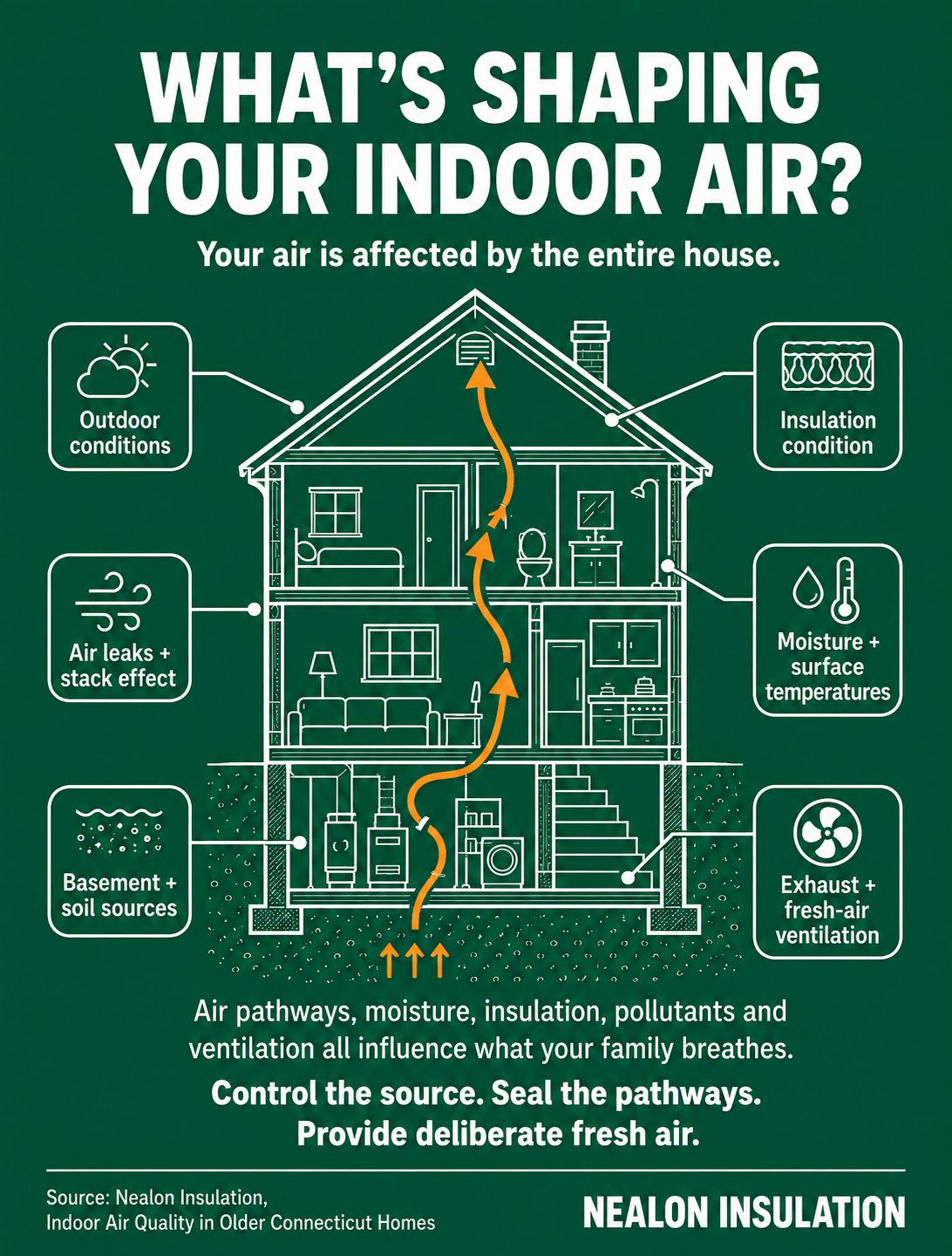
The stack effect pulls air from the worst places in the house
Warm air rises, escapes through the top of your house, and creates suction at the bottom. Your house works like a chimney, and the taller and leakier it is, the harder it draws. In a Connecticut winter, with a 50 degree difference between your living room and the yard, that draw runs strong enough to pull air continuously through rim joists, sill plates, foundation cracks, and crawl space vents.
That is the part most air quality advice misses completely. You are not breathing air that politely wandered in through a window. You are breathing air that got pulled in through the dampest, dirtiest part of the house and then rode the temperature difference straight up into your bedroom.
What that means in a Connecticut basement or crawl space
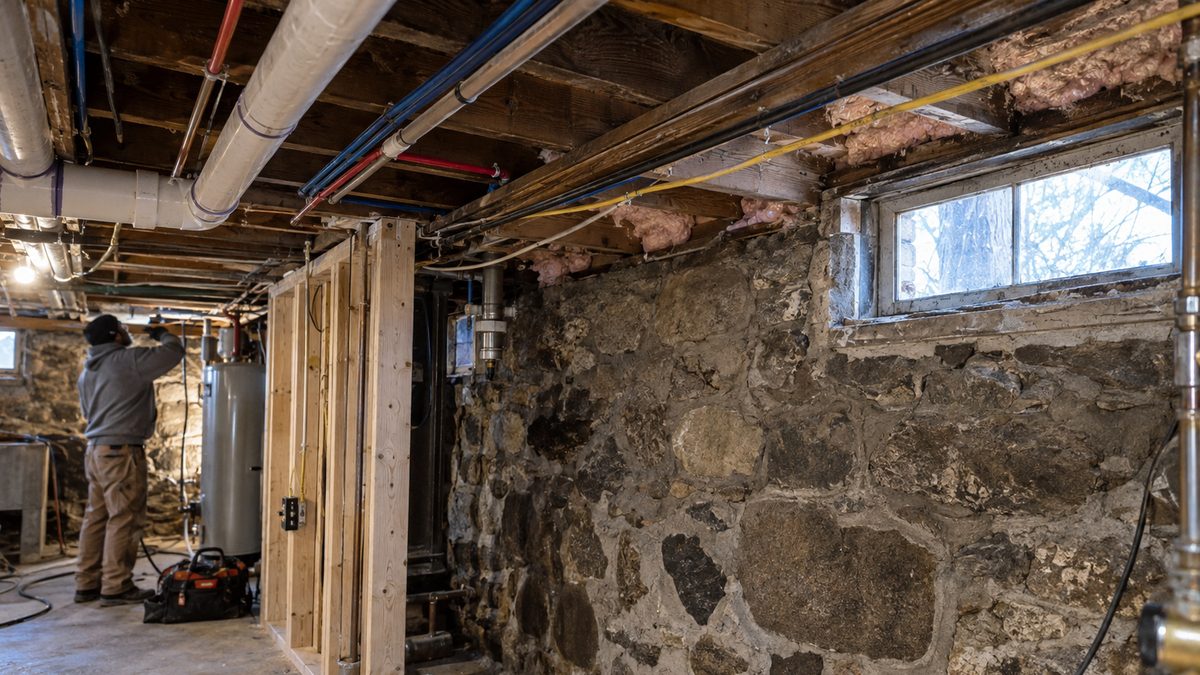
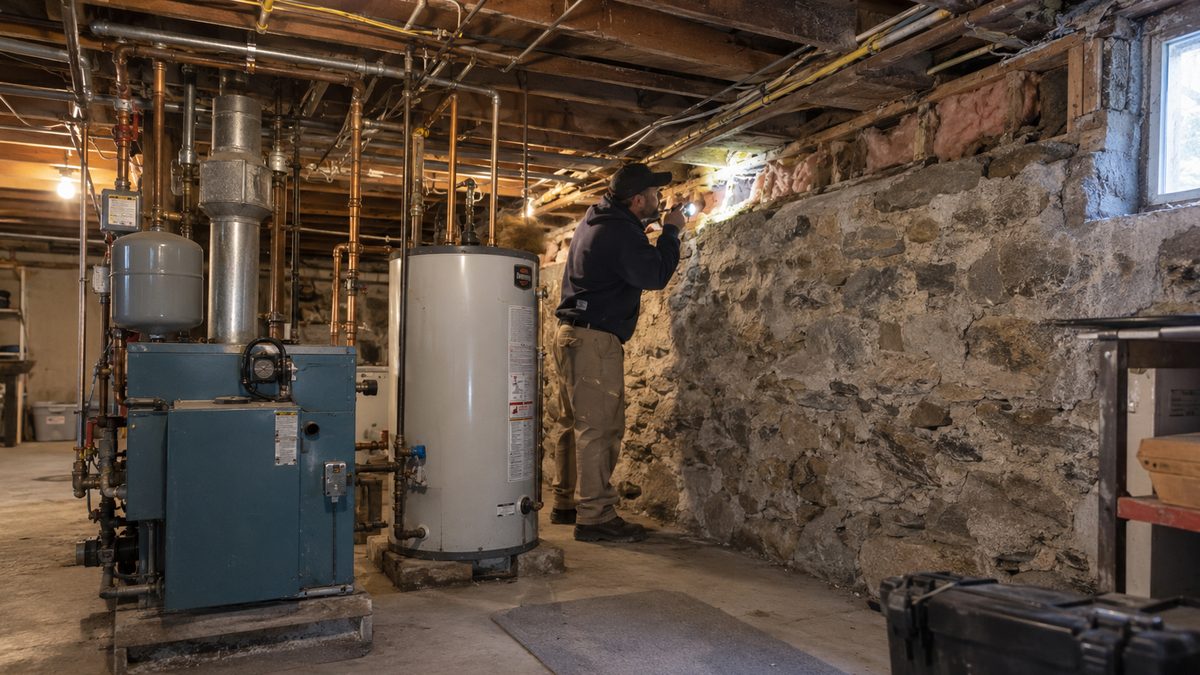
In Connecticut, the air entering the bottom of the house comes off soil, stone, and damp wood. Pre-1980 shoreline homes commonly sit on fieldstone foundations or open crawl spaces with bare dirt floors, and soil is a permanent moisture source. On a humid August afternoon that dirt is releasing moisture into the crawl space air. In February the stack effect is delivering that same air upstairs.
I have crawled under plenty of Connecticut houses where the homeowner had no idea the ground beneath their living room floor was open, wet dirt. Laying a vapor barrier and sealing a dirt-floor crawl space is one of the few moves that changes the smell of an entire house inside a week.
How the stack effect moves air through a Connecticut house
How Air Sealing Changes What Your House Breathes
Air sealing improves indoor air quality by changing which air replaces the air your house loses. It is not only a heating bill measure. When you close the leaks at the top of the house, you weaken the suction at the bottom, and the house stops drawing so hard on the crawl space and the basement.
Sealing the leaks that pull the worst air in
The leaks that matter most for air quality sit at the top of the house, not around the windows. Attic bypasses do the real damage: open top plates, chimney chases, plumbing and wiring penetrations, recessed light housings, and the attic hatch itself. Those are the exits. Close the exits and the entrances lose their pull.
This is exactly why professional air sealing work gets scheduled before an insulation upgrade rather than after. Blowing insulation over an unsealed attic floor buries the leaks without closing them, and the house keeps breathing through the basement.
The tradeoff a tighter house creates
A tighter house concentrates whatever is already inside it. This is the honest part, and plenty of contractors skip it. The EPA has connected rising indoor pollutant concentrations over recent decades partly to energy-efficient construction that does not include enough mechanical ventilation to keep up.
That is not an argument against air sealing. A leaky house is not ventilated, it is uncontrolled, and it happens to draw its makeup air from the worst possible places. The right answer is to seal the envelope and then give the house a deliberate way to breathe, which is a number you can actually calculate.
Why air sealing does more for comfort than adding insulation alone
Insulation, Cold Surfaces, and the Mold You Never See
Insulation improves indoor air quality mainly by keeping surfaces warm enough that moisture never condenses on them. Mold does not require a leak. It requires a cold surface and humid air, and an under-insulated Connecticut house supplies both from November through March.
Warm surfaces stay dry, and dry surfaces do not grow mold
Every surface in your house has a temperature, and when that temperature falls below the dew point of the air touching it, water forms. In an uninsulated rim joist bay, a cold exterior wall cavity, or the ceiling corner above an unheated garage, that happens quietly and repeatedly all winter. You do not see it. You smell it eventually.
Hold indoor relative humidity between 30 and 50 percent, keep surface temperatures up with adequate insulation, and you have removed half the mold equation permanently. A $15 hygrometer on the kitchen counter tells you which side of that range your house is on.
When the insulation itself is the pollutant
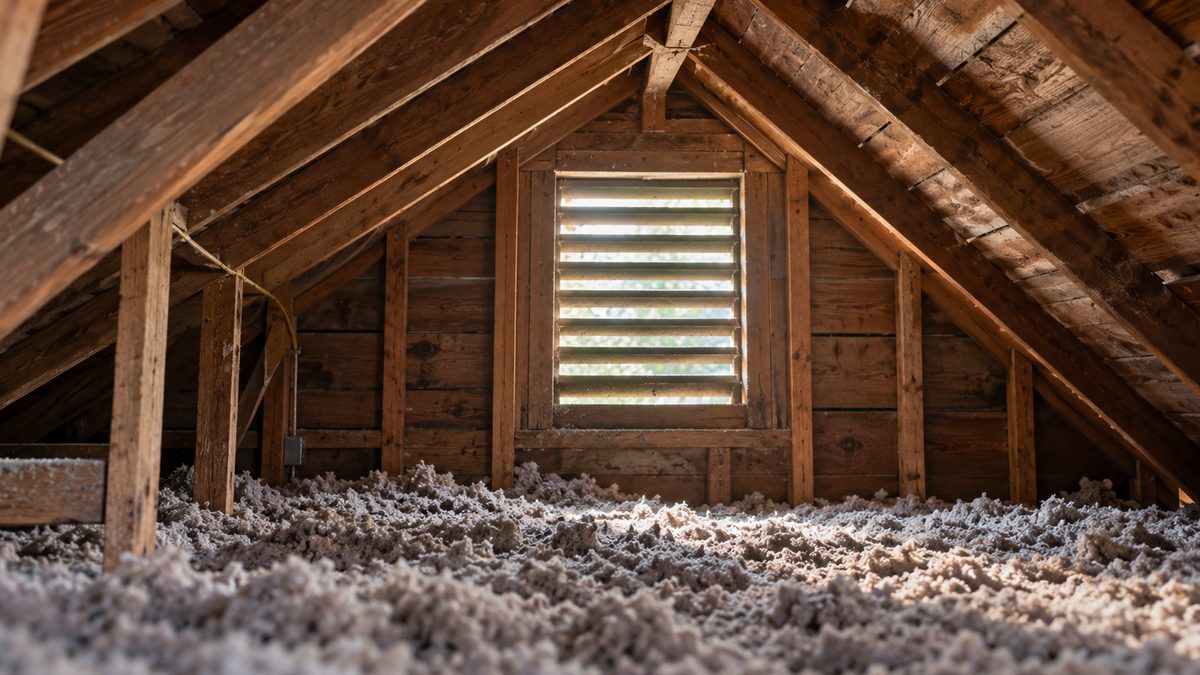
Old insulation is sometimes the source of the problem rather than the fix. Fiberglass that has been wet holds moisture against framing and stays a mold substrate long after the original leak is repaired. Insulation that rodents have nested in carries droppings, urine, and dander, and every bit of stack effect airflow moves some of that upstairs into the living space.
If you find dark staining, matted sections, or a sharp ammonia smell in the attic, the material needs to come out rather than get topped off. What to do when insulation gets wet covers that call in more detail, because homeowners ask about it constantly.
How insulation affects the air you breathe indoors
Radon Is the Connecticut Air Problem Almost Nobody Tests For
Radon is the one indoor air pollutant in Connecticut with a hard number attached to it. It is a naturally occurring radioactive gas that rises out of the soil, and it enters houses exactly the way everything else in this article does: through foundation cracks, sump pits, and plumbing penetrations at the bottom of the house, pulled in by the stack effect.
The Connecticut Department of Public Health puts the numbers plainly:
- The EPA action level is 4 pCi/L. At or above that, fix the house. DPH advises considering a fix between 2 and 4 as well.
- Test between November and March, while the house is closed up. A short-term test kit costs less than a tank of gas.
- A radon mitigation system in Connecticut runs roughly $1,200 and can cut levels by up to 99 percent.
- Retest every two years, and always retest after a basement renovation.
Here is the part worth underlining: elevated radon shows up in every part of Connecticut, and two houses next door to each other can test completely differently. Your neighbor's result tells you nothing about your house.
Sequence matters. Test for radon before you finish a basement or encapsulate a crawl space, not after. Sealing the bottom of a house changes how it moves air, and you want a baseline number in hand first.
How Much Fresh Air Does Your House Actually Need?
There is a published standard that says how much fresh air a house needs, and almost no homeowner has ever seen it. ASHRAE Standard 62.2 sets the target with one formula: 0.03 CFM per square foot of conditioned floor area, plus 7.5 CFM per occupant, counting bedrooms plus one.
Run it on a typical Connecticut colonial at 2,000 square feet with three bedrooms. That is 60 CFM from floor area plus 30 CFM from four assumed occupants, for a target of 90 CFM of continuous fresh air.
Now compare that to what your house actually has. A bathroom exhaust fan moves 50 to 80 CFM while it is running, and it runs maybe 20 minutes a day. That is not a ventilation system, it is a moisture fan. Most older Connecticut homes have never had anything close to 90 CFM of deliberate fresh air, and they got away with it purely because they leaked.
The Five-Minute Indoor Air Walkthrough
You can diagnose most of this yourself this weekend with no tools beyond a phone and a $15 humidity meter. Walk the house and check six things:
- Read the humidity. Put a hygrometer in the main living space. Above 60 percent in summer or below 30 percent in winter both cause problems.
- Open the basement or crawl space door and smell it. Musty, earthy, or sour means the air down there is wet, and the stack effect is delivering it upstairs.
- Check the range hood. Turn it on and hold a tissue up to it. If the tissue does not hold, or if the hood recirculates into the kitchen instead of venting outside, you have no kitchen ventilation at all.
- Check the bath fan the same way. Then go find where it terminates. Fans that dump into the attic are common in older Connecticut homes and they are a mold factory.
- Look at the windows on a cold morning. Condensation on the glass means indoor humidity is running high relative to your surface temperatures.
- Look at the attic insulation. Dark gray staining around recessed lights or the hatch marks air leakage paths. Matted or discolored sections mean moisture has been getting in.
Anything that fails, photograph it. That photo is worth more to a contractor than any description you can give over the phone.
Why your allergies get worse inside your own house
What You Can Fix Yourself and What Needs a Contractor
Plenty of this list is homeowner work, and I would rather tell you that than sell you something you do not need.
The first paid step for most Connecticut homeowners is not an insulation quote. It is a Home Energy Solutions audit through Energize CT, which carries a $40 copay and includes a blower door test that measures how leaky the house actually is. That visit is also where the insulation rebate application gets issued, and Energize CT currently covers up to $2.00 per square foot or 75 percent of project cost, whichever is less, capped at $10,000 per home. What a Connecticut home energy audit actually covers is worth understanding before you book one.
Indoor air quality in an older Connecticut home is a building problem before it is a filter problem. The air you breathe upstairs mostly started somewhere else in the house, and until you change where it comes from, no purifier is going to fix it. Air sealing changes the path, insulation keeps surfaces warm enough to stay dry, a radon test tells you what is coming out of the ground, and the ASHRAE number tells you whether the house has any deliberate fresh air at all.
Start with the free stuff. Read your humidity, smell your basement, confirm your fans actually vent outside, and order a radon test kit for this coming winter. Those four things cost under $40 combined and will tell you more about your air than a year of guessing.
👉 Contact Nealon Insulation — if your house smells like the basement in January, we can find out why before you buy another air purifier.
Frequent Questions About Indoor Air Quality in Older Homes
How much does it cost to fix the air quality problems in an older Connecticut home?
Most homeowners spend between $3,000 and $9,000 to address the building side of indoor air quality in a typical older Connecticut house. That figure usually covers attic air sealing plus an insulation upgrade to the R-49 to R-60 target. Crawl space encapsulation runs separately at $6,000 to $18,000 depending on square footage and access. Radon mitigation adds roughly $1,200 if your test comes back at or above 4 pCi/L. Energize CT rebates cover up to $2.00 per square foot or 75 percent of the insulation portion, capped at $10,000, which changes those numbers considerably.
Will air sealing make my indoor air quality worse?
Air sealing improves indoor air quality in almost every older Connecticut home, because it stops the house from drawing its makeup air through the crawl space and basement. The concern applies to houses that are already tight and get sealed further without any mechanical ventilation added. A blower door test during your Home Energy Solutions audit tells you which situation you are in. If a house tests unusually tight after work, the fix is adding controlled ventilation, not reopening the leaks.
Do I need to remove my old attic insulation, or can you add on top of it?
You can add on top of clean, dry insulation, and in most Connecticut attics that is what we do. Removal is necessary when the existing material is wet, mold-stained, rodent-contaminated, or badly compacted. Adding new insulation over contaminated material traps the problem and keeps the contaminants in the airflow path. A visual inspection settles it in about ten minutes, and removal typically adds $1,500 to $3,500 to a project depending on attic size and access.
Should I test for radon before or after insulating my basement?
Test before. Sealing and insulating the bottom of a house changes how air and soil gas move through it, so you want a baseline reading first. Testing takes 2 to 7 days with a short-term kit, and Connecticut DPH recommends running the test between November and March while the house is closed up. If the result lands at or above 4 pCi/L, handle radon mitigation before or alongside the insulation work rather than discovering the problem afterward.
Does an insulation contractor test air quality, or do I need a separate company?
Insulation contractors address the building conditions that drive indoor air quality, not laboratory air testing. We assess moisture, air leakage paths, ventilation, and insulation condition, and a BPI-certified assessment includes combustion safety testing on your heating equipment. Radon testing goes through a nationally certified radon measurement professional or a DIY kit, and radon mitigation requires a contractor registered with the Connecticut Department of Consumer Protection. Mold testing is its own specialty as well, though in most Connecticut homes the moisture source is obvious enough that testing is not the useful first step.
Related Articles
Let's Work Together
Ready to transform your home into an energy-efficient haven? Schedule your free energy assessment today and experience the Nealon difference for yourself.