
How Nealon Insulation Handles Payments: What to Expect Before, During, and After Your Project
Most homeowners do their homework on insulation — R-values, material types, which contractor has the best reviews. What they don't usually think about until the contract shows up is how the payment actually works. How much is due upfront? What happens if the price changes? Can you pay by credit card? What exactly are you agreeing to before the crew shows up?
Those are fair questions, and they deserve straight answers. This post covers exactly how Nealon Insulation structures payments — from the initial estimate through final walkthrough — so there are no surprises on either side of the job.
What Payment Methods Does Nealon Accept?
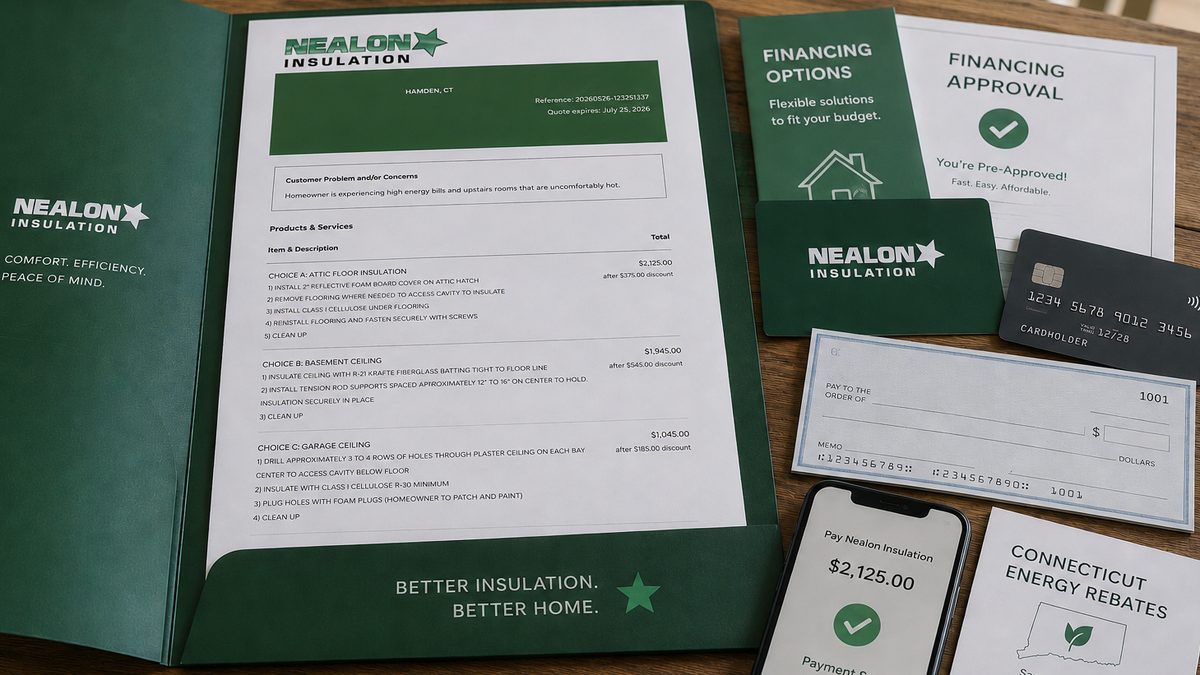
Nealon accepts cash, check, credit card, Zelle, and Venmo. We've kept it straightforward on purpose — no financing programs, no third-party lenders, no jumping through hoops to get your project scheduled.
If you pay by credit card, there's a 3% processing fee added to your total. That's the cost the card networks charge, and we pass it through at cost rather than baking it into everyone's price. If you'd rather avoid it, check, cash, Zelle, or Venmo all work just as well.
How much does insulation actually cost in Connecticut?
How the Deposit Works
Nealon requires a 50% deposit at signing, before any work begins. The remaining 50% is due when the job is complete.
The deposit isn't just a formality. When you sign a contract, we're typically purchasing thousands of dollars of materials specific to your project — insulation doesn't sit in a warehouse waiting for you. On top of that, we're committing crew time and blocking out schedule space that another homeowner could have taken. The deposit makes that commitment real on both sides. You're holding your spot; we're covering the materials to do the job right.
The balance comes due at completion — not before. You don't pay the second half until the work is done and you've had a chance to see it.
What Your Quote Covers — and What Can Change It
Your quote covers exactly what's in the agreed scope of work — the areas, materials, and labor outlined in your contract. Nealon's estimates come in at 99.9% accuracy, meaning what you're quoted is almost always what you pay. That's how we land at that number — and why comparing two insulation quotes side by side tells you more than either number alone.
The one scenario where the price changes is a scope change. If something unexpected turns up during the job — say, we open up an attic in a 1960s colonial and find damage that has to be addressed before insulation can go in — we stop, document it, and get your written approval before doing anything additional. Nothing gets added to your bill without your sign-off first. That's not a policy we bend.
This matters especially in older Connecticut homes, where surprises behind walls and in attics are more the rule than the exception. A good contractor doesn't just barrel through and hand you a bigger invoice at the end. We flag it, explain it, and let you decide.
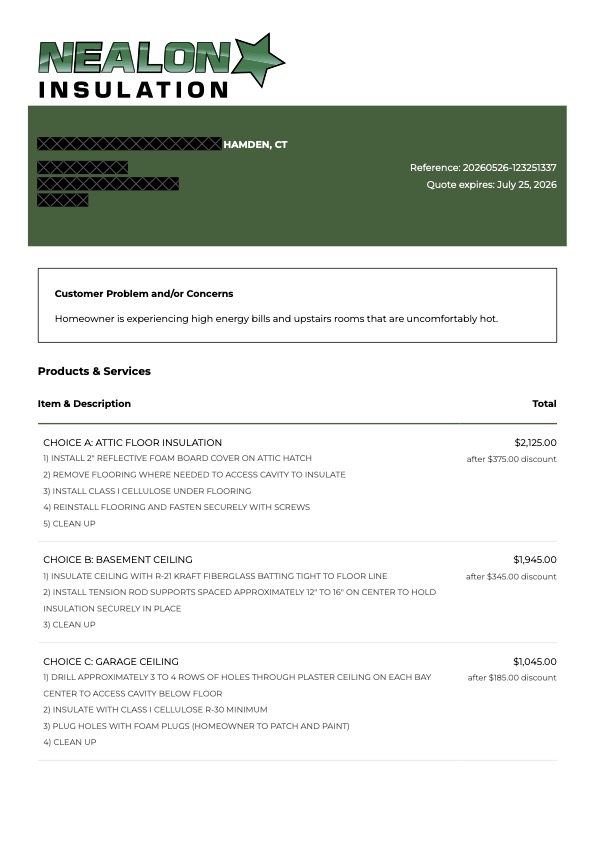
Not sure how to read two competing quotes? Here's how to compare them the right way.
What If You Want to Add More Work Mid-Project?
It happens more than you'd think. The crew is in your attic, and you realize the basement has been bothering you for years. Or you walk through with the foreman and decide you want to add a room that wasn't in the original scope. That's a completely normal conversation to have. If the timing lines up, insulating during a renovation is one of the most cost-efficient moves a homeowner can make.
Here's how it works: we put together a new quote for the additional work, you review it, and nothing starts until you've given written approval. The added cost gets rolled into your final balance due at completion.
The upside of adding work mid-project is real. The crew is already on site, already familiar with your home's layout and quirks, and already set up. That efficiency often means a cleaner job and less disruption than scheduling a second visit weeks later. It's not always possible depending on timing and materials, but when it works, it works well for everyone.
What it will never look like is a verbal agreement followed by a surprise on your final invoice. Every addition is documented before a single extra inch of insulation goes in.
What Happens Before You Pay Anything
Before you sign anything or hand over a deposit, you get a written quote that spells out exactly what work will be done, where, and with what materials. No ballpark figures, no "we'll figure it out when we get there."
The estimate process starts with a walkthrough of the areas you want addressed. We measure, assess current insulation levels, check for any moisture or air sealing issues that would affect the job, and put together a scope based on what we actually see — not a generic square footage estimate pulled from a form. That's how we land at 99.9% accuracy.
A few things worth knowing before you sign:
- Get the quote in writing. Every Nealon estimate is documented. If a contractor gives you a number over the phone and calls it a quote, that's not a quote.
- Understand the scope. The contract should clearly state which areas are being insulated, what R-value is being achieved, and what materials are being used.
- Know your rebate timeline. If you're pursuing Connecticut insulation rebates, those come after the project is complete — not before. You pay Nealon directly, then submit for reimbursement through the rebate program. The rebate doesn't reduce your upfront cost, but it does put real money back in your pocket after the fact.
Want to know what questions to ask before you sign anything? Here are 10 smart ones.
What Happens After the Project Is Completed
When the work is done, we do a final walkthrough with you before we consider the job closed. You get to see exactly what was installed, where, and how. If something doesn't look right or you have questions about what was done in a space you couldn't access during the job, that's the moment to raise it.
Once you're satisfied with the work, the remaining 50% balance is due. That's the trigger — your sign-off, not ours. See average energy savings in Connecticut homes after insulation to understand what to expect once the job is done.
- Rebate documentation. If you're pursuing an Energize CT rebate, we provide the documentation you'll need to submit your claim — installed R-values, materials used, areas covered. You handle the submission, but we make sure you have what you need.
- Callbacks at no extra cost. If something comes up after we leave — a question about the work, a concern that develops over the first few weeks — we come back. That's part of how we operate, not an upsell.
One thing that won't happen: we won't pack up and disappear the moment the check clears. Connecticut winters are unforgiving, and we'd rather know the job is holding up than find out through a bad review six months later.
Curious what Connecticut homeowners can get back through Energize CT? Here's the full breakdown.
The Nealon Promise
Every project we take on comes with a straightforward guarantee: the work we agreed on will be done correctly, to the same standard we'd want in our own homes.
That's not marketing language. It's the bar we hold ourselves to on every job, whether it's a single attic in a Cape Cod or a full basement and crawl space overhaul in a 1950s colonial. Highest quality standards aren't something we advertise and then quietly walk back when a job gets complicated.
In practical terms, the Nealon Promise means two things:
- The work is done right. We don't cut corners on materials, coverage, or air sealing because a job ran long or the crew wanted to get home early.
- If it's not right, we come back. Callbacks are at no extra cost. If something isn't performing the way it should, we show up and fix it. No runaround, no finger-pointing at the homeowner's existing conditions.
When you're writing a check for an insulation project — and for most Connecticut homes, that's a meaningful amount of money — you're not just paying for blown-in cellulose or spray foam. You're paying for the accountability that comes with it. That's what the Nealon Promise is built on.
Wondering what to look for when choosing an insulation company? Here's how to evaluate your options.
Frequent Questions About Insulation Contractor Payment Terms
Is a deposit standard practice for insulation contractors?
A deposit is standard across the home improvement industry, and most reputable insulation contractors require one. It covers materials purchased specifically for your project and secures your place on the schedule. A contractor who asks for no money upfront and no written contract is a red flag worth taking seriously.
What happens if I'm not happy with the work when it's done?
Nealon does a final walkthrough with you before the job is considered closed. If something isn't right, that's the moment to raise it — before the final payment is due. If a concern develops after the crew leaves, callbacks are covered at no extra cost under the Nealon Promise.
Can I split my payment across multiple credit cards?
Nealon can work with you on how you'd like to structure payment, but each credit card transaction carries the 3% processing fee. If you're looking to spread the cost without the fee, check, cash, Zelle, or Venmo are all accepted and have no added charges.
How long after the project is complete do I need to pay the final balance?
The final 50% balance is due at project completion, once the final walkthrough is done and you're satisfied with the work. Nealon doesn't send invoices with net-30 terms — payment is collected at the close of the job, not weeks later.
Does Nealon provide any documentation I can use for taxes or rebates after the project?
Nealon provides documentation after project completion covering installed R-values, materials used, and areas insulated. This paperwork supports Energize CT rebate submissions. For tax purposes, consult your accountant — some energy-efficiency improvements qualify for federal tax credits, and having detailed project documentation makes that process easier.
Paying for an insulation project doesn't have to feel like a leap of faith. When the process is transparent — written quotes, documented scope, written approval before any changes, and a final walkthrough before the last dollar changes hands — you know exactly what you're getting and when you're getting it. That's how Nealon has operated since 1977, and it's not something we plan to change.
If you're ready to get a straight answer on what your project will cost and how the payment process works, reach out and we'll walk you through it.
👉 Contact Nealon Insulation — get a written estimate and a clear picture of exactly what your insulation project will cost.
Related Articles


Let's Work Together
Ready to transform your home into an energy-efficient haven? Schedule your free energy assessment today and experience the Nealon difference for yourself.