
Can You Use Blown-In Insulation in a Crawl Space?
Most homeowners don't think much about their crawl space until something forces them to. Maybe it's floors that feel like walking on a refrigerator in February. Maybe it's a musty smell that shows up every summer and won't go away. Maybe someone told them their energy bills are high because of poor insulation and they're finally ready to do something about it.
So they start researching. They've heard blown-in insulation is great — and it is, in the right application. They figure: insulation is insulation, right? If it works in the attic, it'll work under the house too.
That's where the confusion starts.
Crawl spaces are their own world. They have different geometry, different moisture dynamics, and different failure modes than any other part of the house. What works great overhead doesn't always translate to what's happening six inches off the ground. And in Connecticut — where older homes are the norm, winters are cold, and shoreline humidity is relentless — getting this decision wrong can turn a straightforward insulation project into a mold and rot problem that costs significantly more to fix.
This post is going to answer the blown-in question directly, explain why crawl space insulation works differently than most people expect, and lay out what actually gets the job done in a Connecticut home. No fluff — just a straight answer on what works, what doesn't, and why it matters.
First, Understand What Kind of Crawl Space You Have
Before anyone answers whether blown-in insulation works in a crawl space, you need to answer a more basic question first: is your crawl space vented or unvented?
This isn't just a technical detail. It's the whole ballgame.
Vented crawl space
A vented crawl space has foundation vents that allow outside air to move through. The old-school thinking was that ventilation would keep moisture from building up. In theory, fine. In practice — especially here in Connecticut — you're pulling in humid summer air that condenses on cool surfaces inside and causes exactly the moisture problems you were trying to avoid. Vented crawl spaces are still common in older Connecticut homes, and they come with their own set of rules for insulation.
Unvented (encapsulated) crawl space
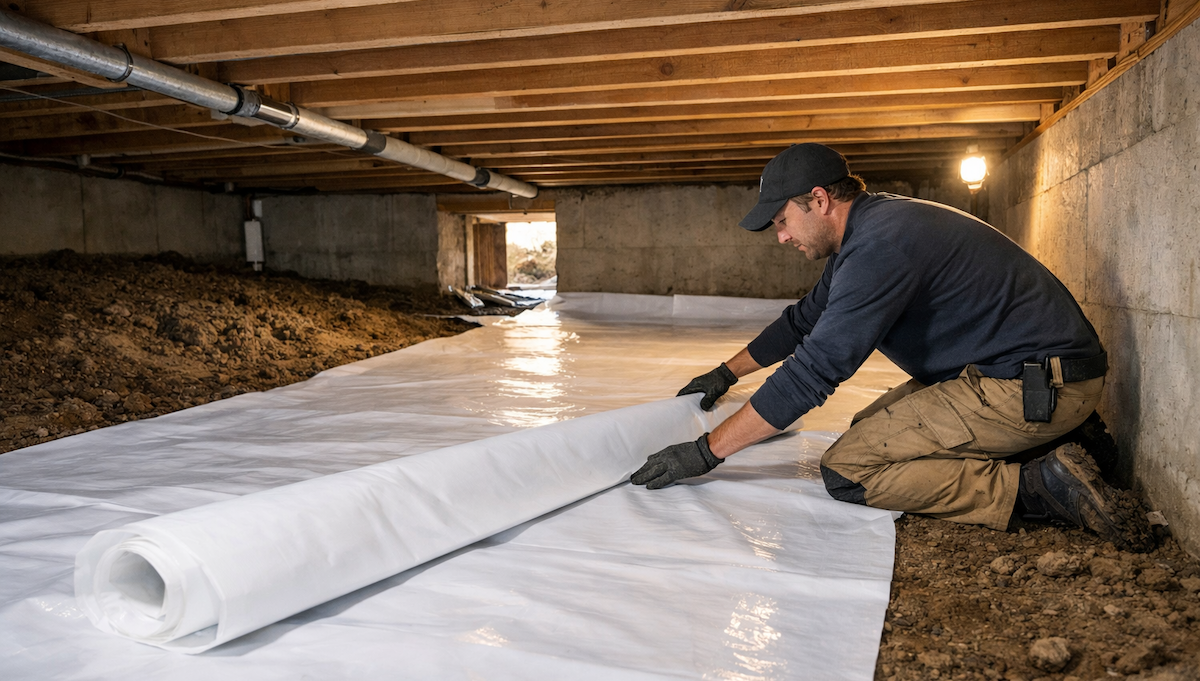
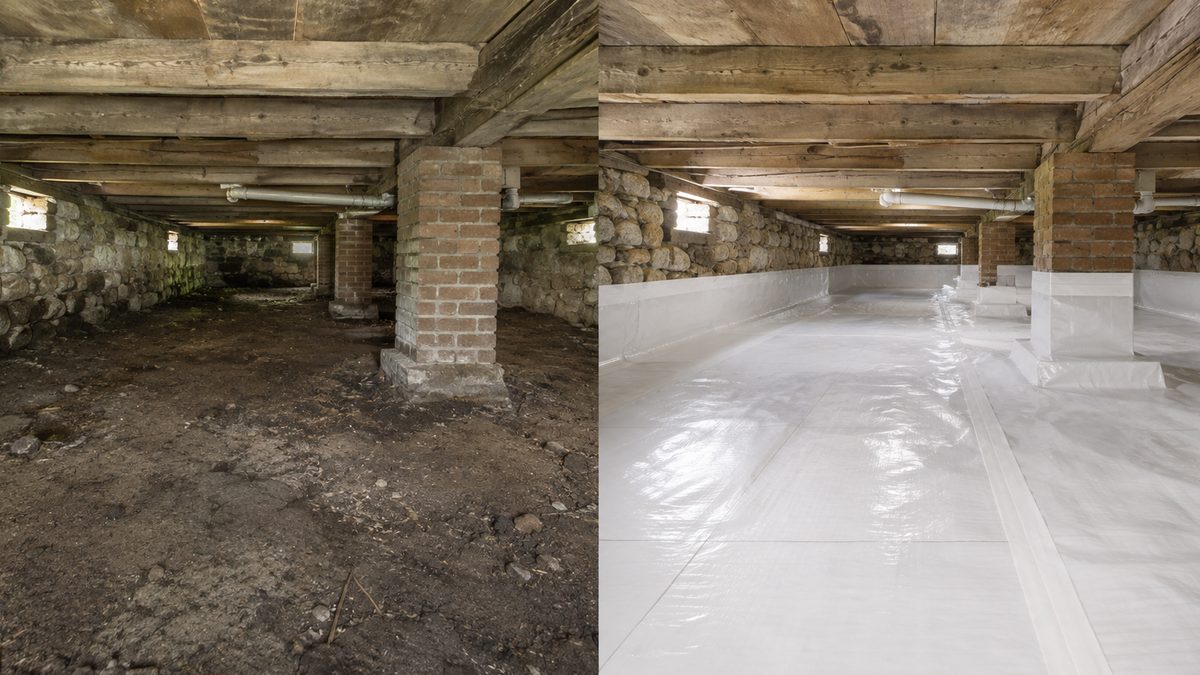
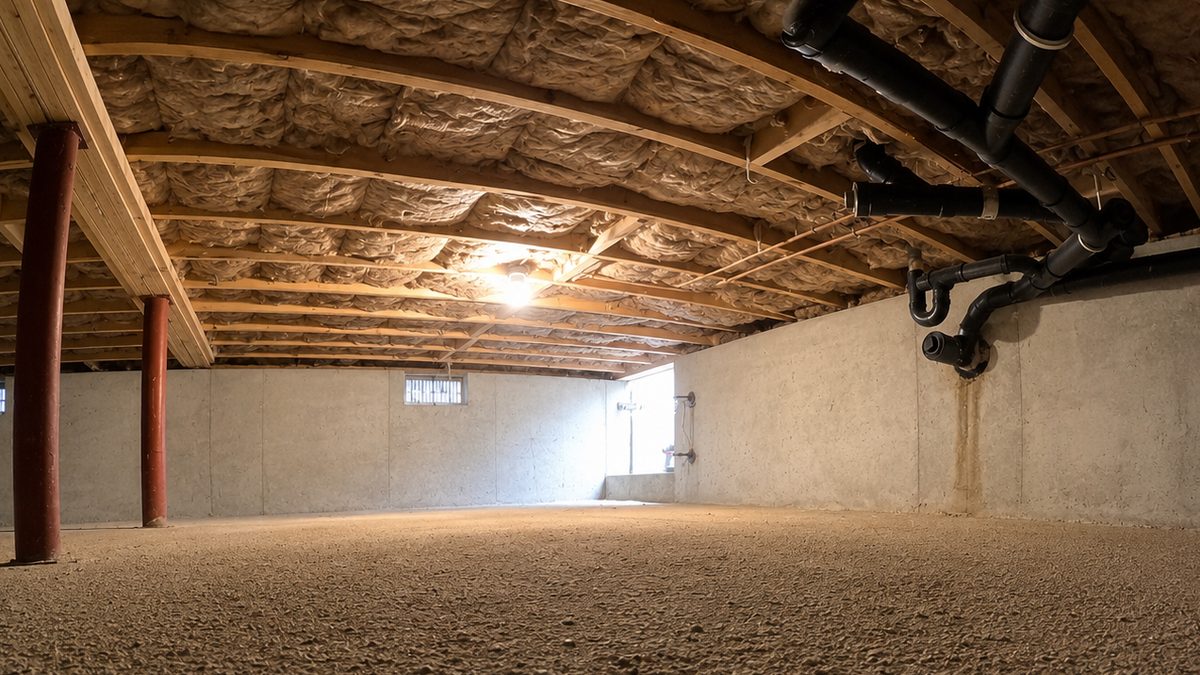
An unvented crawl space is sealed off from outside air. The ground is covered with a heavy vapor barrier, the walls are insulated instead of the floor above, and the space is treated more like a conditioned zone than an afterthought. This approach has become the preferred method for good reason — it handles Connecticut's humidity better and performs more consistently year-round.
Why does this matter for blown-in insulation? Because each crawl space type points you toward a completely different insulation strategy. And in both cases, blown-in isn't really the answer.
Learn more about crawl space encapsulation.
The Short Answer — Blown-In Isn't the Right Tool Here
Blown-in insulation is excellent. It's one of the best ways to insulate an attic, fill wall cavities, and cover irregular spaces where batts won't lay flat. But crawl spaces are a different animal, and using blown-in down there tends to create more problems than it solves.
Here's the core issue: blown-in insulation needs something solid to land on and stay put. In an attic, that's your ceiling drywall. In a crawl space, you're working in a completely different geometry — insulating the floor system above you, not a flat surface below you. Blown-in cellulose or fiberglass can't hang between floor joists. It'll fall, shift, settle, or just sit on the ground doing nothing useful.
Some contractors have tried blowing insulation into net-enclosed joist bays — stapling a mesh across the bottom of the joists and blowing material in behind it. It can be done, but it's fussy, labor-intensive, and still leaves you exposed to the bigger problem: moisture.
Crawl spaces are damp environments. Even a "dry" crawl space in Connecticut sees humidity fluctuations throughout the year — especially on the shoreline. Here's how the two most common blown-in materials hold up compared to better-suited alternatives:
The bottom line: blown-in insulation was engineered for different applications. Putting it in a crawl space is a bit like using a flathead screwdriver on a Phillips head screw. You might make it work, but there's a better tool for the job.
What Actually Works in a Crawl Space
So if blown-in is out, what's the right move? It depends on that vented vs. unvented question from earlier — but here's how each scenario plays out.
Vented crawl space: insulate the floor above
If you have a vented crawl space and you're not ready to fully encapsulate it, the standard approach is to insulate between the floor joists using fiberglass batts. The batts are friction-fit between the joists and held in place with wire rods, mesh, or insulation supports. You're putting a thermal barrier between the cold crawl space and the living space above it.
For Connecticut homes, you're targeting R-19 to R-30 in the floor assembly depending on your specific situation. Done right, it makes a real difference in cold floors and heating costs.
One important note: a vapor barrier on the ground is not optional here. If you're insulating a vented crawl space without controlling ground moisture first, you're setting yourself up for rot and mold problems down the road.
Unvented crawl space: insulate the walls and rim joists
This is where spray foam earns its place. In an encapsulated crawl space, you insulate the foundation walls and rim joists rather than the floor above. Closed-cell spray foam is the go-to — it insulates, air seals, and acts as a vapor retarder all in one application. That's a big deal in a space where moisture control is everything.
Rigid foam board is another option for the crawl space walls, installed in combination with a heavy-duty vapor barrier on the floor and walls. It's more budget-friendly than spray foam but requires more careful detailing to get the air sealing right.
Full encapsulation
More and more Connecticut homeowners are moving toward full crawl space encapsulation — sealing the ground and walls with a thick poly liner, insulating the perimeter, and sometimes adding a dehumidifier to actively manage humidity. It costs more upfront than simply batting between the joists, but it transforms the crawl space from a liability into a clean, dry, usable part of the house. For shoreline homes dealing with persistent moisture issues, it's often the only long-term solution that actually holds up.
Not sure which crawl space insulation material is actually best for your situation? We broke it down.
The Moisture Problem Connecticut Homeowners Can't Ignore
If you're anywhere near the Connecticut shoreline, moisture in your crawl space isn't a hypothetical — it's a when, not an if. And it's the single biggest reason why insulation decisions in crawl spaces need to be made carefully.
Here's what's working against you:
- Ground moisture wicks up through soil and concrete year-round
- In summer, warm humid air flows into vented crawl spaces and condenses on cooler surfaces — floor joists, pipes, the underside of your subfloor
- In winter, temperature swings create their own condensation cycles
- Coastal humidity on the shoreline compounds all of this from May through October
When insulation gets wet in a crawl space, a few things happen — none of them good:
- Fiberglass batts that absorb moisture lose a significant portion of their R-value and don't fully recover when they dry out
- Cellulose holds moisture longer and can become a food source for mold
- Wood rot follows — and once you've got soft joists or a compromised subfloor, you're no longer talking about an insulation project, you're talking about a structural repair
- Wet, compressed insulation is prime real estate for rodents looking to nest
The point isn't to scare anyone. It's to make clear that in Connecticut crawl spaces, the insulation material and method you choose has to account for moisture first. An R-value that looks great on paper doesn't mean much if the product can't hold up to the environment it's sitting in. To understand exactly how blown-in fiberglass holds up to moisture compared to spray foam, that breakdown is worth a read before you make any decisions.
If moisture is already showing up in your crawl space, here's how we approach mold treatment and remediation.
Air Sealing the Crawl Space — The Step Most People Skip
Insulation slows heat transfer. Air sealing stops air movement. You need both — and in a crawl space, most homeowners only think about one of them.
The rim joist is the biggest offender. That's the band of framing that sits on top of your foundation wall and closes off the floor system around the perimeter of the house. It's full of gaps, penetrations, and transitions between different materials — exactly the kind of detail that leaks air like a sieve. On a cold Connecticut morning, those rim joists are often where the cold is getting in and the heat is getting out.
Beyond the rim joist, there are other air leakage points worth addressing:
- Plumbing and electrical penetrations through the subfloor
- Gaps around ducts running through the crawl space
- Any opening where conditioned space meets the crawl space environment
In a vented crawl space, cut-and-cobble rigid foam with canned spray foam around the edges handles the rim joist well. In an encapsulated crawl space, spray foam applied directly to the rim joist takes care of both insulation and air sealing in one shot.
Here's the practical reality: a crawl space that's been insulated but not air sealed will still have cold floors, still have drafts, and still underperform on energy bills. The insulation is doing its job — the air is just going around it. Think of it like stuffing a draft stopper under a door but leaving the window wide open next to it.
Air sealing isn't an add-on. It's part of the job.
Wondering what it actually costs to air seal a Connecticut home? Here's the full breakdown.
What About Cost and Rebates?
Crawl space insulation isn't the cheapest project on the list, but it's one of the better ones when you look at what you actually get out of it.
The cost varies depending on what your crawl space needs:
- A straightforward batt insulation job in a vented crawl space with a vapor barrier sits at one end of the range
- A full encapsulation with spray foam on the walls, rim joists, and a dehumidifier sits at the other
- Size, access, existing conditions, and any moisture remediation needed all factor into the final number
Connecticut energy costs are not kind. The state consistently ranks among the highest in the country for residential electricity and heating fuel prices. A crawl space that's leaking conditioned air all winter is a real and recurring expense — not just an abstract inefficiency.
The good news is that Energize CT rebates can offset some of the cost. Connecticut homeowners may qualify for rebates on crawl space insulation and air sealing work performed by a participating contractor. The specific amounts and eligibility requirements can change, so the best move is to check directly with Energize CT or ask your insulation contractor to walk you through what's currently available. In many cases, a Home Energy Assessment through Energize CT is the starting point — it identifies the biggest opportunities in your home and can unlock additional incentives.
The return on investment here isn't just financial. Warmer floors in January. Less humidity creeping up through the house in August. A crawl space that doesn't make you wince every time you open the access hatch. Those things have real value even before you factor in the energy savings.
Crawl spaces don't get a lot of attention, but they punch well above their weight when it comes to comfort, energy efficiency, and moisture control in a Connecticut home. The floors above them, the air quality throughout the house, and the structural integrity of the framing are all directly affected by how well that space is managed.
Blown-in insulation is a great product — just not for this application. The geometry doesn't work, the moisture exposure is too high, and there are better tools specifically suited for what a crawl space needs. Whether that's batts between the joists in a vented crawl space, spray foam on the walls and rim joists in an encapsulated one, or full encapsulation with a vapor barrier and dehumidifier, the right answer depends on what you're actually working with down there.
The one thing that's true across every crawl space scenario: air sealing matters as much as insulation, and moisture control has to come first. Skip either one and you're building on a shaky foundation — sometimes literally.
If your crawl space is on your radar — cold floors, high bills, mystery smells, or you just haven't thought about it in years — it's worth having someone take a look before winter reminds you it exists.
👉 Contact Nealon Insulation to get a straight answer on what your crawl space actually needs — and what it'll take to fix it right.
Frequent Questions About Blown-In Insulation in Crawl Spaces
Can I just add a vapor barrier without insulating my crawl space?
You can, and it's better than nothing — but a vapor barrier alone doesn't do much for energy efficiency or cold floors. What a vapor barrier does is control ground moisture from wicking up into the framing and insulation above it. What it doesn't do is slow heat loss through the floor system or stop cold air from moving through the space. In a vented crawl space, you need both — a vapor barrier on the ground and insulation between the floor joists — to actually address comfort and energy performance. In an encapsulated crawl space, the vapor barrier is part of a larger system that includes insulation on the walls and rim joists. One without the other is half a job.
How do I know if my crawl space insulation has failed?
A few reliable signs. Cold floors in winter — especially in rooms directly above the crawl space — are the most common complaint. A musty or earthy smell coming up through the floors or into living spaces is another strong indicator, usually pointing to moisture damage or mold in the insulation. If you're comfortable getting into the crawl space, look for insulation that's sagging, falling down, visibly wet or stained, compressed, or shredded. Any of those conditions means the insulation has lost most of its effectiveness and needs to be replaced, not patched. In older Connecticut homes, it's not unusual to find original insulation that's been down there for 30 or 40 years — long past its useful life.
Is crawl space encapsulation worth the cost in Connecticut?
For most Connecticut homeowners — especially on the shoreline — yes. The upfront cost is higher than a standard batt insulation job, but encapsulation addresses the root cause of crawl space problems rather than just the symptoms. You're controlling ground moisture, stopping humid air infiltration, insulating the perimeter, and in many cases adding a dehumidifier to actively manage the environment down there. The result is a crawl space that stays dry year-round, protects your framing and subfloor from rot, and contributes meaningfully to whole-house energy performance. Homes on the shoreline that deal with persistent humidity issues often find that encapsulation is the only approach that actually holds up long-term. When you factor in avoided repair costs — rot remediation, mold treatment, structural repairs — the math tends to work in encapsulation's favor.
Will insulating my crawl space actually lower my energy bills?
It can, and often does — but the impact depends on how bad the existing conditions are and whether air sealing is done at the same time. Insulation alone slows heat transfer through the floor. Air sealing stops conditioned air from escaping through gaps in the rim joist and floor penetrations. Done together, homeowners in older Connecticut homes frequently notice a meaningful reduction in heating costs, particularly if the crawl space was previously uninsulated or had badly degraded insulation. Cold floors disappearing is usually the first thing people notice — lower bills follow. The exact savings depend on your home's size, heating system, and existing conditions, which is why a Home Energy Assessment through Energize CT is a useful starting point before committing to a scope of work.
How long does crawl space insulation last?
It depends on the material and the conditions. Fiberglass batts in a properly maintained vented crawl space with a good vapor barrier can last 20 years or more — but only if moisture is controlled. In a damp or uncontrolled crawl space, the same batts can fail in five to ten years. Spray foam applied to an encapsulated crawl space holds up significantly longer and is far less vulnerable to moisture degradation. The honest answer is that crawl space insulation lasts as long as the conditions allow it to. If the moisture problem isn't addressed, no insulation material will perform the way it should. That's why the condition of the crawl space itself matters as much as what you put in it.
Related Articles
Let's Work Together
Ready to transform your home into an energy-efficient haven? Schedule your free energy assessment today and experience the Nealon difference for yourself.