
Air Sealing vs Insulation: Should You Air Seal or Insulate First?
If your house feels drafty in winter, overheats in summer, or somehow manages to be uncomfortable year-round despite decent insulation, you’re not alone. Most homeowners eventually land on the same question: Do I need air sealing or insulation—and which should I tackle first?
It’s a fair question. Both upgrades promise lower energy bills and better comfort. Both show up in energy audits. Both get pitched by contractors. And both are often misunderstood.
The problem is that air sealing and insulation are often treated as interchangeable. They’re not. They do different jobs, solve different problems, and—most importantly—deliver very different results depending on the order they’re done.
Get the sequence wrong, and you can spend real money only to see marginal improvements. Get it right, and the same house can feel tighter, quieter, and more comfortable without touching the thermostat.
This article breaks down the difference between air sealing and insulation, explains how they interact, and gives you a clear, practical answer to which one usually comes first—without marketing fluff or building-science jargon.
What’s the Difference Between Air Sealing and Insulation?
Air sealing and insulation often get lumped together because they both appear on energy-saving checklists. In reality, they address two very different issues.
Air sealing stops uncontrolled air movement. Every home has gaps and penetrations that let outdoor air in and conditioned air out—attic hatches, rim joists, recessed lights, plumbing chases, and top plates, to name a few. Air sealing closes those pathways so air stays where it belongs.
Learn more about why air sealing is important.
Insulation slows heat transfer. It resists the flow of heat through walls, ceilings, and floors. Insulation does not stop air from moving—it simply reduces how quickly heat passes through materials.
Learn more about heat transfer.
Here’s the key distinction:
- Air sealing controls movement
- Insulation controls resistance
One keeps air in place. The other slows heat loss. They work best together, but they are not the same upgrade—and treating them as such is where many homeowners go wrong.
How Air Leaks Undermine Insulation Performance
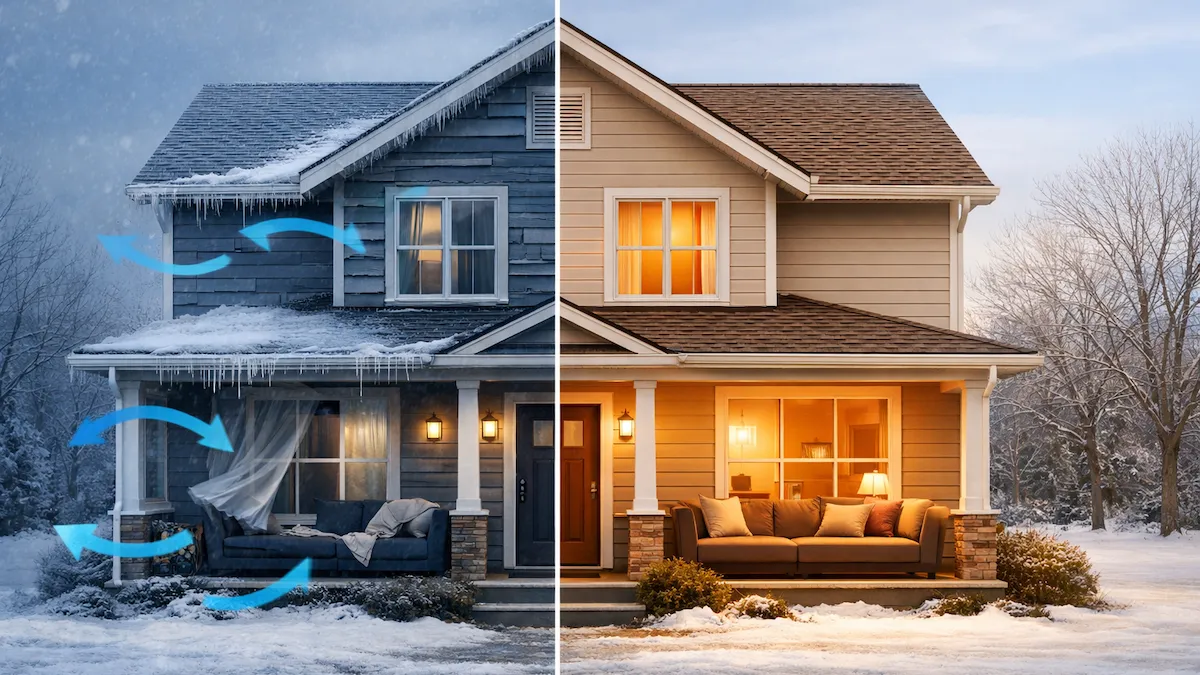
Insulation is designed to slow heat transfer, not block airflow. When air leaks freely through a home, it can bypass insulation entirely, carrying heat with it as it goes. This is one of the most common reasons homeowners add insulation and still feel drafts or see only modest savings.
Air leaks create pressure-driven movement inside a house. Warm air rises and escapes through upper levels, pulling cold air in from lower areas to replace it. This cycle—often called the stack effect—turns small gaps into major energy drains.
A simple analogy helps. Imagine wearing a thick winter jacket with the zipper open. The insulation is there, but the moving air strips heat away faster than the material can slow it. That’s exactly what happens in a leaky house.
Common symptoms include:
- Cold floors or chilly exterior walls
- Drafts near outlets, baseboards, or stairwells
- Rooms that feel colder even when the thermostat reads correctly
Until those air leaks are sealed, adding more insulation often delivers diminishing returns.
Air Sealing vs Insulation: Which Should You Do First?
In most homes, air sealing should come first.
That answer surprises many homeowners, especially those who equate energy efficiency with insulation thickness or R-value. But if air is leaking freely, insulation is fighting a losing battle.
Air sealing tackles the biggest and most wasteful source of energy loss: leakage. By closing gaps at the attic, basement, and key transition points, you reduce the amount of heated or cooled air escaping the home. Once that air stays put, insulation can finally do the job it was designed to do.
Homes that are air sealed first typically see:
- Fewer drafts and more even temperatures
- Improved comfort without raising thermostat settings
- Better real-world performance from existing or new insulation
There’s also a practical reason for this order. Many of the best air sealing locations are easiest to access before insulation is added. Seal first, insulate second, and you avoid burying air leaks under new material.
When Insulation Makes Sense to Tackle First
There are exceptions, though they’re less common.
Insulation may come first when:
- The home is new construction or undergoing a major renovation
- Air sealing is already being addressed through design and materials
- A blower door test shows low air leakage but insulation levels are clearly inadequate
In these cases, insulation upgrades can deliver meaningful gains without sacrificing performance, especially when some incidental air sealing occurs during installation.
The key difference is intent. Insulation-first approaches work when air leakage is already controlled or when both measures are addressed together. Without that context, insulation alone can feel like treating the symptom instead of the cause.
How Much Energy Can Air Sealing and Insulation Actually Save?
Both air sealing and insulation reduce energy use, but the size and reliability of those savings depend on the home and the order of work.
Air sealing often delivers the most immediate improvement. In leaky homes—especially older ones—uncontrolled air loss can account for a large share of heating and cooling costs. Sealing those leaks reduces demand on HVAC systems right away.
Insulation savings tend to be more gradual. Adding insulation to poorly insulated areas like attics can reduce heat loss, but if air leakage remains high, the payoff is often muted.
That’s why diagnostic tools matter. Blower door testing and energy audits reveal where energy is actually being lost. In leaky homes, air sealing produces stronger returns. In tighter homes with low insulation levels, insulation may drive the bigger gain.
The most consistent long-term savings come when air sealing and insulation are treated as a system.
Cost Comparison: Air Sealing vs Insulation
From a cost standpoint, these upgrades behave very differently.
Air sealing typically has:
- Lower upfront cost
- Targeted scope of work
- Faster payback in leaky homes
Insulation costs scale with square footage, depth, and material. It’s a larger investment and delivers the best return once the home is tight enough to hold conditioned air.
A common mistake is spending heavily on insulation before sealing major leaks. When results fall short, homeowners assume insulation “doesn’t work,” when in reality the house was still leaking air.
For most homes, air sealing is the most efficient first dollar spent. Insulation becomes more cost-effective once leakage is under control.
How to Tell What Your Home Needs Most
You can often tell a lot by how your home behaves.
Signs air sealing is needed:
- Drafts near floors, outlets, or stairwells
- Temperature differences between floors
- High winter heating bills
Signs insulation may be the limiting factor:
- Few drafts, but rooms won’t hold temperature
- Thin or uneven attic insulation
- Cold ceilings or persistent hot spots in summer
A professional energy audit removes guesswork. Blower door testing measures leakage, while infrared imaging highlights insulation gaps. The data usually points to a clear priority.
Why Air Sealing and Insulation Work Best as a System
Air sealing controls where air can move. Insulation controls how heat moves. Ignore either one, and performance suffers.
Together, they:
- Improve comfort room to room
- Reduce moisture risks from uncontrolled air movement
- Allow HVAC systems to run more efficiently
When planned as a system, the home performs more predictably—and comfortably—year-round.
Common Homeowner Mistakes When Choosing Between Air Sealing and Insulation
Some of the most common missteps include:
- Chasing R-value without addressing air leaks
- Assuming newer homes don’t need air sealing
- Sealing only visible gaps while missing major leak paths
- Relying on DIY fixes without a plan
Avoiding these mistakes starts with understanding how the house works as a whole.
Air Sealing vs Insulation for Older Homes and Cold Climates
Older homes and cold climates amplify air leakage problems. Larger indoor-outdoor temperature differences create strong pressure forces that drive warm air out and cold air in.
In these homes:
- Air sealing often delivers outsized comfort improvements
- Insulation performs better once leakage is reduced
- Energy savings are more noticeable and more reliable
For homes built before modern energy codes, prioritizing air sealing is often the difference between incremental improvement and a real transformation.
The Bottom Line: Air Sealing vs Insulation — What to Do First
In most existing homes, air sealing should come first.
Stopping uncontrolled air movement addresses the largest source of energy loss and allows insulation to perform as intended. Insulation remains essential, but its impact is strongest when the house is already tight enough to hold conditioned air.
The smartest approach isn’t choosing one over the other—it’s sequencing them correctly.
Ready to Decide What Your Home Actually Needs?
Every house is different. Some are leaky. Some are under-insulated. Most deal with both. The only way to know which upgrade will deliver the biggest payoff is to evaluate the home as a system.
👉 If you want clear answers and a smart plan—not a one-size-fits-all recommendation—get in touch. Contact Nealon Insulation.
FAQ's on Air Sealing and Insulation
How do I know if air sealing will actually be worth the money in my home?
Air sealing is worth the cost when air leakage causes energy loss and comfort problems. Homes with drafts, uneven temperatures, or high heating bills usually benefit most. A professional energy audit or blower door test confirms value by measuring leakage and identifying major air loss areas.
If I can only afford one upgrade right now, which will give me the biggest improvement?
Air sealing delivers the biggest immediate improvement for most homes. It stops drafts, reduces temperature swings, and cuts energy waste caused by air leaks. Homeowners usually feel comfort gains right away. Insulation works best after air leaks are sealed, making air sealing the smarter first upgrade.
Will I notice a difference right away after air sealing or insulation?
Most homeowners notice a difference immediately after air sealing. Drafts stop, temperatures feel more even, and cold floors or walls become less noticeable the same day. Insulation also improves comfort, but results are often slower if air leaks remain. Air sealing delivers faster, more noticeable comfort gains.
Can air sealing or insulation cause problems with ventilation or moisture?
Properly installed air sealing and insulation reduce ventilation and moisture problems instead of causing them. Air leaks allow moisture to enter walls and attics, leading to condensation and mold. Sealing those leaks controls airflow. Contractors manage ventilation intentionally to keep moisture balanced and indoor air healthy.
What’s the smartest way to move forward without guessing or overspending?
The smartest way to move forward is to start with a whole-home energy assessment. A professional evaluation identifies where energy loss actually occurs and which upgrades deliver the best return first. This approach prevents upgrades in the wrong order and replaces guesswork with a clear, cost-effective plan.
Related Articles
Let's Work Together
Ready to transform your home into an energy-efficient haven? Schedule your free energy assessment today and experience the Nealon difference for yourself.